
The GROWTH Advantage: An Effective Blueprint for Transformational Coaching
Picture this: You’ve just been promoted to lead a team—an energetic mix of individuals with differing skills, knowledge, expertise, and, sometimes, clashing personalities. Although you clearly demonstrate strong product knowledge and effective project management skills, your team’s performance is inconsistent, with results falling short of expectations. The group lacks cohesion, and their motivation and morale are low. You’re left feeling frustrated, wondering what it’ll take to turn things around. If you find yourself in a similar situation, know that you’re not alone.
While many leaders possess subject matter expertise and the management skills required to oversee tasks, they frequently experience challenges in leading the team. According to the Greenleaf Center for Servant Leadership, (servant) leaders bring out the best in their teams not by controlling and managing, but by coaching and mentoring, which empowers teams to reach their full potential.
Developing effective coaching and mentoring skills can make all the difference in transforming individuals into a cohesive, high-performing team that is inspired and motivated—one that is built on trust and confidence. An International Coaching Federation (ICF) study found that coaching significantly improves performance; specifically, a 70% increase in individual performance, 50% increase in team performance, and 48% increase in organizational performance.
If you’re facing a similar challenge and want to strengthen your coaching and mentoring skills, consider starting by exploring and practicing time-tested approaches before investing heavily in formal training. Begin your journey by learning about proven strategies, applying them in real-world scenarios, and evaluating effectiveness.
Wondering where to start? Try the GROW coaching framework—it is effective and easy to use. The GROW framework simplifies the coaching process into four clear steps, making it easy to follow and implement. Whether you are new to coaching or have considerable experience, this methodology provides a structured framework that can help you develop your coaching and mentoring skills. The GROW framework is effective for coaching individuals and groups toward progress and success in both business and community settings.
What is the GROW Framework?
Sir John Whitmore and Graham Alexander, along with their colleagues, developed the GROW framework in the early 1990s as a way to boost employee development and enhance performance. Although originally designed for workplace settings, the GROW framework is versatile and can be applied to all coaching and mentoring contexts, regardless of background or situation. Today, GROW continues to be a fundamental approach for coaches, leaders, and organizations looking for practical strategies to foster development and improve performance.
The GROW model—representing Goal, Reality, Options, and (Will) Way Forward—offers a straightforward, structured approach to coaching. By guiding individuals through four essential stages—clarifying objectives, assessing the current situation, exploring possible strategies and obstacles, and establishing a commitment to action—it empowers individuals to find their own solutions. This framework nurtures a sense of accountability and encourages sustainable, meaningful progress.
The GROW model is grounded in the belief that thoughtful questioning, rather than providing direct instructions, is key to driving meaningful, lasting change. Rather than telling individuals exactly what to do, coaches using GROW guide them to uncover their own answers through timely, purposeful questions. This method encourages individuals to clarify their goals and build effective action plans, fostering a sense of ownership and lasting commitment to their objectives.
The GROW framework serves as a practical guide for individuals and teams to set realistic, meaningful goals and objectives. By helping individuals clarify what they truly want to achieve, the model not only inspires motivation but also reinforces the importance of commitment and accountability throughout the process. Establishing clear, attainable goals through GROW drives individuals to improve performance, solve problems, make better decisions, learn new skills, and reach their goals.
GROW vs. GROWTH
The GROW model is a foundational four‑step coaching framework—Goal, Reality, Options, and (Will) Way Forward—designed to support performance improvement and effective goal setting. It helps individuals clarify what they want to achieve, understand their current situation, explore possible paths forward, and commit to specific actions.
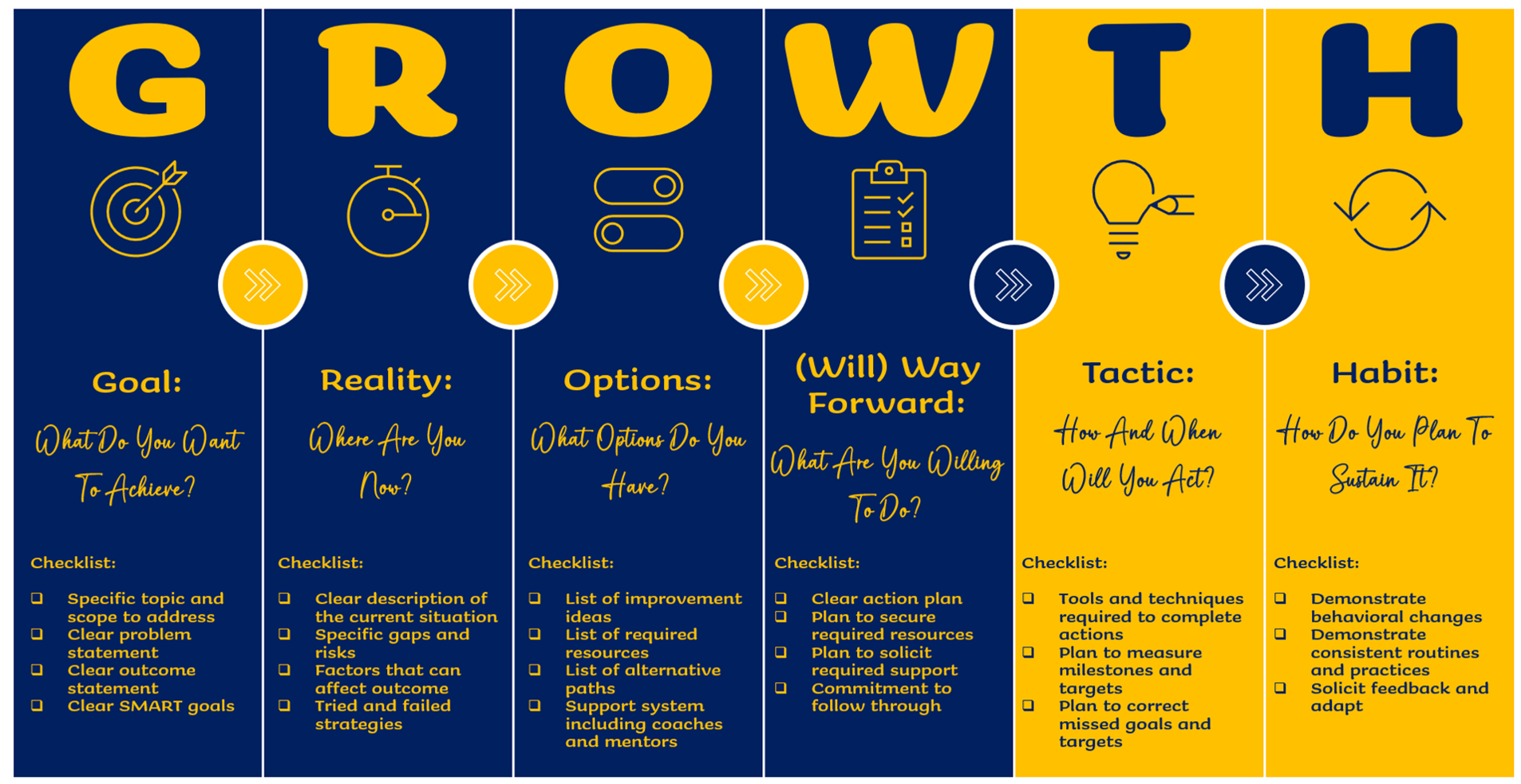
Building on this foundation, the GROWTH model extends the framework—Goal, Reality, Options, (Will) Way Forward, Tactics, and Habits—to strengthen sustainability and long‑term follow‑through. The added components, Tactics and Habits, ensure that individuals not only commit to action but also develop the practical strategies and consistent behaviors required to maintain progress over time.
While GROW is highly effective for immediate problem‑solving, short‑term decisions, and performance improvement, GROWTH is designed for deeper and lasting behavioral change. It shifts the focus from simply identifying actions to embedding new habits and routines that support continuous growth and long‑term success.
How to Apply GROWTH
Before applying the GROWTH model, coaches and mentors must understand several key implementation principles and ensure these are clearly communicated and mutually agreed upon with participants. Without shared clarity, the process can break down, leading to frustration, loss of confidence, and diminished trust in the coaching effort.
Avoid overwhelming participants by targeting too many goals at once. Selecting one or two meaningful goals per individual or team increases focus, builds confidence, and improves the likelihood of success.
GROWTH is a six‑step framework that requires routine engagement. Leaders and participants must commit to meeting regularly, reviewing each phase, tracking progress, and taking corrective action when needed. Both parties share responsibility for completing each step, sustaining momentum throughout, and achieving the desired outcomes.
When identifying the problem statement, setting goals, and outlining actions, be specific about scope, boundaries, and expectations. Avoid overly broad, ambiguous, or unrealistic objectives—focus on goals that are attainable, measurable, and aligned with available resources. Try not to solve world hunger.
While aiming to “get it right the first time” is admirable, action plans must remain adaptable to evolving changes. Participants should be encouraged to evaluate progress, incorporate feedback, and adjust their approach as needed to stay aligned with their goals.
Sustainable success requires more than completing tasks—it demands genuine, long‑term behavioral shifts. Participants must be willing to fully engage in the process, follow through on commitments, and adopt new habits that reinforce the desired change. Partial effort or temporary compliance will not produce meaningful or lasting results.
Ready to start using the GROWTH framework? Here is a detailed step-by-step guide for using GROWTH for coaching and mentoring individuals.
Step 1: Set the Goal
Objective: Begin by defining a clear problem statement. To create a well‑bounded and actionable statement, first establish an understanding of the desired future state and the expected outcome. Focus on a single, specific problem with realistic boundaries to maintain a manageable scope. Once the problem statement is defined, articulate the desired outcome—ensuring it is feasible, measurable, and within reach. Finally, set clear goals to track progress and recognize accomplishments.
Consider using the SMART goal setting framework to create effective goals, ensuring goals are Specific, Measurable, Achievable, Relevant, and Time-Bound.
Goals can take many forms, including:
Performance goals: Process 100 expense reports per day by June.
Development goals: Earn an Agile Scrum Certification within three months.
Improvement goals: Reduce cycle time to close actions by 50%.
Decision‑making goals: Decide whether to accept a new job offer.
Problem‑solving goals: Reduce competing priorities from 10+ to the top two by June.
Outputs: The primary deliverables from this stage consist of a well-defined problem statement, a clearly specified desired outcome, and corresponding SMART goals.
Key Questions:
What do you want to change, and why is this change important?
What do you want to achieve as a result of this change?
How does this goal align with your existing priorities?
What is the broader context or bigger picture surrounding this goal?
How does this goal fit into that bigger picture?
What would success look like for you?
Why is this goal important to you at this moment?
What additional motivations are driving this goal?
What needs or values are you trying to fulfill through this goal?
What would the ideal outcome be?
What benefits will you gain if you achieve this goal?
What expectations do others have regarding this goal?
How might others perceive or be affected by this change?
How much control or influence do you have to achieve this goal?
Do you need support from individuals, teams, networks, or organizations?
What resources, expertise, or skills are required for success?
What does success look like?
How will you know when you have achieved your goal?
What actions or steps will move you toward this goal?
How will you measure progress and determine whether the goal has been met?
What is the time frame for achieving this goal?
How realistic and attainable is this goal given your current situation?
Step 2: Compare with Current Reality
Objective: Before drafting a plan to pursue the goals, it is essential to understand the current situation—the strengths, weaknesses, challenges, areas for improvement, and existing best practices that may influence the outcome. Identify obstacles that should be avoided, as well as proven practices that can be leveraged. Examine any strategies that were previously attempted and failed, along with the contributing factors behind those failures and how relevant they are to meeting the goal. Determine whether any existing barriers or constraints could make the goals unrealistic or unattainable. Whenever possible, use historical data to quantify past successes and setbacks and assess how these insights should shape the path forward.
Consider using the Keep–Start–Stop (KSS) technique to evaluate the current state and identify gaps, opportunities, and areas for improvement.
Outputs: Key outputs from this step include a clear understanding of the challenges, gaps, and risks that must be addressed. Additional outputs may include a list of actors, obstacles, and dependencies that could negatively impact the outcome and should be avoided; a list of best practices, expertise, and resources that can be leveraged to positively influence the outcome; and new ideas, opportunities, or changes that could further improve the results.
Key Questions:
What is the current reality or situation?
What is missing or not working in the current situation?
What is working well right now?
What is holding you back or limiting progress?
What elements would you like to keep, stop, or start as you pursue this goal?
What other relevant factors should be considered?
What strengths can you leverage, and what weaknesses should you avoid?
Does this goal conflict with any other goals or priorities?
What environmental or contextual factors are influencing the situation?
Who is involved—directly or indirectly—and what are their perceptions?
How might this situation or goal affect others?
Based on your intuition, what do you believe is really going on?
What impact is the current situation having on results or outcomes?
What has contributed to your success so far?
What obstacles or challenges are you currently experiencing?
What evidence, examples, or data support your view of the situation?
What actions have you taken so far, and what results did they produce?
What can you learn from what has not worked?
What assumptions might you be holding that could influence your perspective?
How have you handled similar circumstances in the past, and how does that compare to the current situation?
Step 3: Explore Options
Objective: This stage focuses on brainstorming and generating a range of potential strategies, actions, and resources that could help you achieve your goal. It is important to explore multiple options and thoughtfully weigh their pros and cons to determine the most effective path forward. Validate assumptions, assess influencing factors, consider available resources, and analyze potential benefits as you explore each option. Avoid limiting yourself to familiar or conventional approaches—be willing to take calculated risks. Embrace creativity and innovation, think beyond traditional boundaries, and engage others to gather new ideas, solicit feedback, and gain additional insight.
Consider using an empirical, experiment‑driven approach: Test different options, analyze the results, incorporate feedback, and refine solutions based on what you learn.
Outputs: The outputs from this stage include the best options to implement and alternative options to pursue if the preferred choices are not selected or need to be replaced. Supporting output also includes required resources and a defined support network that participants can rely on for guidance and assistance.
Key Questions:
Which option do you feel ready to act on?
What are some different ways you could approach this?
What could you do to change the situation?
What alternatives are there to that approach?
What are the pros and cons of each option?
What assumptions are you making?
What dependencies or influencing factors have you considered?
If you could start over, what would you do differently?
What would happen if you did nothing?
What approaches have been used in similar situations?
What could you do differently this time?
What is one possibility you have not considered yet?
If anything were possible, what would you choose to do?
What resources do you need, and who might be able to help?
How much control do you have over each solution?
Who else influences or controls the solution?
How would your options change if you had more time, resources, budget, or authority?
Who could offer valuable insight or guidance as you work toward your goal?
Are you open to input or feedback from others?
Without filtering or judging them, what top options come to mind?
What are the best and worst aspects of each option?
Which options interest you the most?
Which options do you like the most?
What excites or intrigues you about a particular option?
How feasible and realistic is each option?
How could you break this option into smaller, manageable steps?
What else could you do?
Step 4: Determine a Way Forward
Objective: It is not enough to have a well‑defined goal and a list of potential options—decisive action is required to bring the goal to life. This is the planning and execution phase of GROW, where the most suitable option is selected, a clear roadmap with timelines is created, next steps are identified, and a firm commitment to act is established. Participants take action toward their goals, track their progress, and meet consistently with coaches or mentors to maintain motivation, receive guidance, and uphold accountability. Clarity in actions, expected outputs, and commitment to follow‑through are essential in this phase.
Coaches and mentors play a critical role at this stage. They help participants understand their responsibilities, provide guidance on avoiding obstacles and barriers, identify key influencers who can support success, and assist in sourcing necessary resources. They also monitor progress and offer constructive feedback to ensure participants remain aligned, motivated, and on track.
Outputs: The primary outputs of this stage are the selected option to pursue and a clear commitment to deliver. Additional key outputs include a defined roadmap with deadlines, established performance indicators and methods for measuring progress, and the resources secured to begin implementation.
Key Questions:
What option appears to be the best overall?
Which option is the most realistic and feasible?
Which option are you choosing to implement?
To what extent does this option meet all your objectives?
What key indicators and measurements will define your success?
What does your roadmap look like?
What are your key milestone dates?
How can you break this solution into manageable steps?
What are your immediate next steps?
When will each action start and finish?
What is a realistic timeline for achieving success?
How will you know when you are done?
What potential obstacles could interfere with your progress?
What reluctance or hesitation do you have about taking these steps?
What resources are available to support your implementation?
What support do you need, and from whom?
What actions will you take to secure that support, and by when?
What factors or individuals are influencing or hindering your progress?
What actions will you take to address or eliminate these internal or external barriers?
On a scale of 1–10, what is your level of commitment to taking these actions, and what prevents it from being a 10?
On a scale of 1–10, what is the likelihood of your plan succeeding? What would raise it to a 10? And what prevents it from being a 10?
How will you maintain accountability throughout the process?
How will you sustain momentum if progress becomes slow or difficult?
What could stop your progress, and how will you overcome those challenges?
How frequently should you review your progress—daily, weekly, or monthly?
When should you schedule follow‑up check‑ins to discuss your progress?
How will you celebrate each goal or milestone you achieve?
Step 5: Identify Tactics and Develop Habits Required to Make and Sustain the Change
Objective: These stages focus on cementing commitment and creating the conditions for sustained success by putting the right tactics and support systems in place. Tactics are short‑term, intentional actions designed to achieve an immediate goal or solve a specific problem, while habits are automatic, repetitive behaviors that shape long‑term outcomes and impact. The objective is to identify the right tactics that help form lasting habits—the behaviors and mindsets that ultimately drive transformation.
While tactics and habits vary depending on the goal, environment, and available resources, several foundational tactics are common across most change‑management and coaching contexts. Here are a few core ideas to consider as you design your approach:
Forming Habits With Convenient Tactics: Develop a list of the habits required to implement the change effectively with lasting impact and identify the tactics that can be applied to form those habits easier. Tactics can be simple, practical triggers that reinforce the desired habit. For example: Leaving a book on your pillow (tactic) to build a habit of reading; parking farther away (tactic) to increase daily steps (habit); setting a 15‑minute reminder (tactic) to develop punctuality (habit); volunteering at a community organization (tactic) to strengthen interpersonal skills (habit); or using a to‑do list app (tactic) to build consistent planning and prioritization habits.
Tracking and Reporting Progress: Establish clear methods for gathering, analyzing, and communicating data related to performance and progress indicators. Define the tools, formats, and platforms that will be used to share updates. Create the right environment by identifying the appropriate audience, setting a consistent meeting cadence, and ensuring regular opportunities to review and report progress.
Selecting Tools and Systems: Determine the tools, techniques, and procedures that will be used to complete tasks and track progress. Seek guidance when additional expertise is needed.
Scheduling Consistent Review Meetings: Set up recurring check‑ins with coaches or mentors and remain committed to attending them. Select meeting times, formats, and platforms that are convenient for all parties. Capture notes, actions, and decisions, and share them after each meeting.
Creating a Feedback and Support Process: Establish a structured method for soliciting feedback from colleagues, peers, and key partners. Choose a format and platform that fosters transparency, openness, mutual respect, and psychological safety. Document feedback and action items and review progress during subsequent meetings.
Evaluating Evolving Conditions: Define a process for monitoring evolving conditions and variables, new influencing factors, and emerging risks. Incorporate the changes to adjust plans as needed and use empirical testing to validate new assumptions.
Building a Support Network: Identify a group of peers or “cheerleaders” who share similar goals or values and can help maintain motivation and commitment. Join a group or club with similar goals and objectives, share your experience, and learn from others in the same situation.
Establishing a Reward System: Define how wins, milestones, and achievements will be celebrated to reinforce momentum and sustain engagement.
Outputs: Key deliverables in this stage include performance and progress reports, revised plans in response to risks or setbacks, and celebrations of milestones and wins.
Key Questions:
What tools, techniques, and procedures are you using to meet your goal?
What behaviors or situations are you focused on changing?
What tactics are you using to form the habits?
Do you need help or guidance in understanding or applying them?
How are you collecting and reporting your metrics?
How are you performing against your goal?
What challenges are you currently facing?
Who is helping you overcome these challenges?
How often do you meet with your coaches or mentors?
When was your last meeting, and when is your next one scheduled?
What were the key outcomes or actions from your last meeting?
How are you collecting feedback?
Are you receiving sufficient feedback?
How are you acting on the feedback you receive?
Have any conditions or variables changed that could negatively impact your goal?
Have any influencing factors or individuals changed?
How are you addressing these changes?
Do you need to revisit or test any of your assumptions?
How can you keep yourself motivated?
Do you have peers who can cheer you on and support you?
What was your most recent win?
How did you reward yourself for that win?
How do you respond when you miss a goal or deliverable?
Why Coaching and Mentoring are Important
Project management methodologies and frameworks consistently emphasize the importance of coaching and mentoring as foundational guiding principles. For example, Agile is rooted in coaching practices that empower and develop autonomous teams; servant leadership highlights the transformative impact of supporting and guiding team members rather than directing or controlling them; and the ADKAR change management model reinforces the need for coaching and mentoring at every stage of the change process. Together, these approaches demonstrate that effective project delivery depends not only on processes and tools, but also on the continuous development and support of people through coaching and mentoring. Here are several additional situations where coaching and mentoring provide meaningful value and measurable impact:
Enhancing Employee Well-Being: Coaching serves as a vital bridge between personal aspirations and broader strategic objectives, aligning individual effort with a shared organizational purpose. When people set clear, measurable personal goals that directly support organizational priorities, they remain motivated and develop a deeper sense of purpose, belonging, and commitment. As individuals achieve these goals, their engagement and confidence grow. Coaches reinforce this momentum by offering constructive feedback, supporting individuals when targets are missed, and encouraging continued development when progress is strong.
Improving Broader Project or Product Outcome: Coaching also enables leaders to identify strengths, opportunities, risks, and gaps that may influence broader project or product outcomes. This insight allows teams to respond proactively, close performance gaps, and mitigate risks before they escalate. By fostering an inclusive, open, and psychologically safe environment, coaching reduces miscommunication and encourages individuals to share diverse perspectives, provide constructive input, and engage in objective analysis. This collaborative approach strengthens problem‑solving, fuels innovation, and supports the creation of advanced, next‑generation solutions.
Effective Change Management: Because change is inevitable in every organization, coaching plays a critical role in helping teams accept, adapt to, and act on that change. Effective coaching helps individuals understand what the change is, why it matters, and how it will affect them and the broader organization. It also clarifies the role and responsibilities of each participant in implementing the change successfully. Through coaching, teams develop a growth mindset—viewing change not as a disruption or threat but as an opportunity for learning, improvement, and long‑term development, ultimately strengthening the success of implementation.
Creating a Healthy Working Environment: Team coaching further clarifies roles and responsibilities, ensuring alignment with shared goals and fostering consensus. This clarity supports the development of autonomous, empowered teams. Coaching also strengthens a culture of open communication and mutual respect, elevating morale and reinforcing commitment. When employees receive coaching and mentoring, they feel valued—leading to higher motivation and stronger engagement. Research consistently shows that employees who experience satisfaction and connection within their teams are more likely to stay, ultimately improving retention.
According to ICF, 70% of Fortune 500 companies use executive coaching. In those organizations, 70% of individuals report improved work performance after coaching (ICF), and 62% of employees are highly engaged (ICF). Investing in coaching strengthens organizational results and boosts employee performance and confidence.
Key Attributes for Success
Whether guiding a team through change or striving to elevate performance, mastering the traits of an effective coach or mentor leads to stronger results, deeper relationships, and long‑term personal and professional growth. Exceptional coaches and mentors inspire others by demonstrating empathy, communicating with purpose, modeling strong values, and fostering collaboration. Leadership is ultimately about driving outcomes while empowering others to grow. At its core, it is the practice of helping your team rise to new challenges and achieve shared goals. Below are key qualities that define effective coaches and mentors:
Passion and Motivation: Ignite enthusiasm by connecting work to purpose and creating an environment that inspires people to perform at their best.
Lead With Empathy: Listen attentively, value diverse perspectives, and respond with understanding to build trust and mutual respect.
Communicate Strategically: Share information with clarity, intention, and meaning to inspire action, influence decisions, and strengthen commitment.
Encourage Risk‑Taking and Innovation: Embrace an empirical, adaptive mindset—experiment, test assumptions, learn from outcomes, and pursue innovative solutions.
Frame Actions in Terms of Value: Clearly communicate priorities in terms of expected benefits to reduce uncertainty, align efforts, and motivate the team.
Offer Constructive Feedback With Clarity: Provide purposeful, thoughtful feedback that builds confidence, supports growth, and reinforces continuous improvement.
Resilience and Adaptability: Maintain a positive outlook during setbacks and remain agile in changing environments. Treat challenges as opportunities for learning and advancement.
See the Human, Not Just the Role: Build meaningful relationships by understanding the personal experiences, needs, and struggles individuals face beyond the workplace.
Strong Conflict Resolution Skills: Address disagreements constructively by encouraging open dialogue, listening actively, and guiding teams toward fair, respectful outcomes.
Celebrate Successes: Recognize achievements and highlight individual contributions. Celebrating wins boosts morale, fuels creativity, and inspires continued innovation.
Conclusion
If you are in a position to coach or mentor an individual to improve their performance or a team to achieve a new goal, approach the role with intention and genuine commitment. They are placing their trust in you to guide them toward a better outcome and help them reach their goals. Using a structured model, like GROWTH, provides a proven, reliable framework that supports clarity, accountability, and meaningful progress.
GROWTH is a six‑step process that helps define clear goals, develop actionable plans to achieve them, and build lasting habits that sustain change. It is not a “one‑and‑done” exercise. Success requires consistent follow‑through: Meeting regularly to review progress, offering constructive feedback, adjusting plans when necessary, and staying focused on the intended outcomes. And throughout the journey, remember to celebrate successes both big and small, reinforcing momentum and keeping strong motivation.
