
Unlocking Success With Acceptance Criteria and Definition of Done: Building the Right Product and Building It Right
Imagine pouring months of hard work into a project and gearing up for an exciting launch. But when the big day arrives, the results fall flat. Despite building the product and conducting thorough testing, it still missed the target and failed to meet essential requirements. Frustration sets in as you try to pinpoint what went wrong.
Often, the problem does not stem from building or testing deliverables, but from a lack of clear Acceptance Criteria (AC) and a well-defined Definition of Done (DoD). Without a concrete understanding of what “done” means—or what qualifies as “acceptable”—your project may appear perfect on paper but fall short in practice.
So, what sets successful projects apart? A well-defined, actionable Acceptance Criteria and a clearly crafted Definition of Done that everyone understands and supports. These aren’t just industry buzzwords; they serve as guiding principles, helping you avoid uncertainty and clarify expectations.
But how do you tell them apart? While people often use these terms interchangeably, they both have very specific goals and roles. This article intends to define their meanings, outline their purpose and value, discuss practical applications, and review examples from real-world contexts.
What Are Acceptance Criteria and Definition of Done?

The Definition of Done and Acceptance Criteria are two essential concepts within the realm of product development. Although the Definition of Done is often introduced and closely associated with agile methodologies, both Acceptance Criteria and the Definition of Done are applicable across various environments where products and services are created. Each concept fulfills a unique and crucial role in ensuring product quality and the satisfaction of requirements.
Acceptance Criteria are tailored to individual deliverables and serve to confirm that each deliverable meets the explicit requirements established for it. These criteria are defined for every task and provide the basis for testing the functionality and performance of the deliverable against the specified requirements. By clearly outlining what is expected, Acceptance Criteria aid in verifying that the correct product is being built and that it addresses the needs and expectations of stakeholders.
On the other hand, Definition of Done encompasses a comprehensive set of quality standards and attributes that are applied across the product. Rather than being confined to an individual deliverable, it functions as a benchmark for ensuring that every component of the product conforms to established guidelines for quality, compliance, and conformance.
In short:
Acceptance Criteria assure the right product is built.
Definition of Done assures the product is built right.
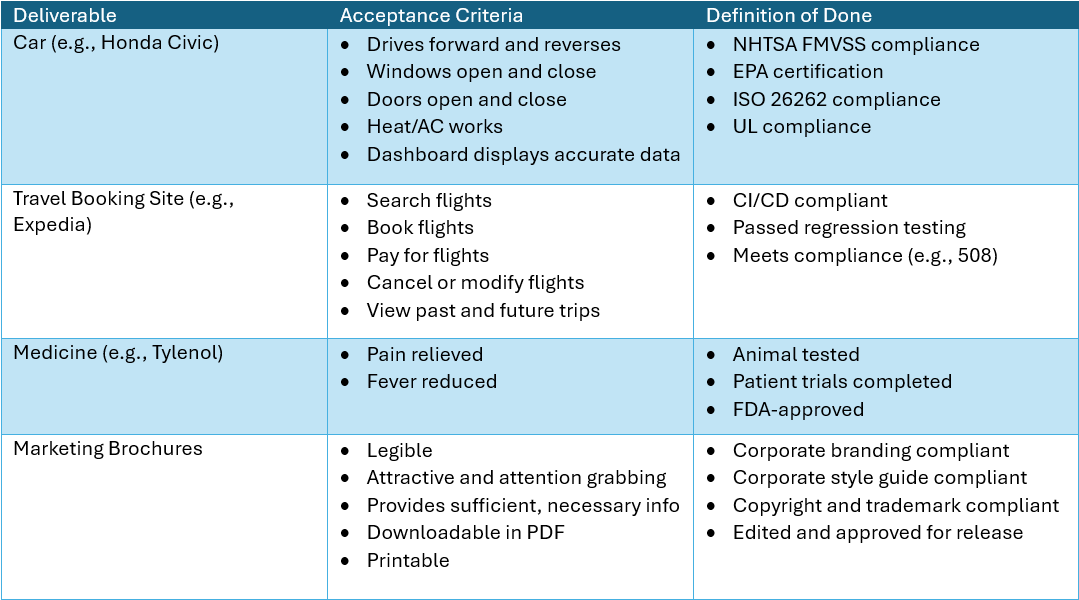
To illustrate these concepts in practical terms, consider the development of a car. The Acceptance Criteria ensure that the vehicle accomplishes its primary purpose: Transporting a person from point A to point B safely, efficiently, and reliably. This means all features—such as the engine, brakes, and navigation system—are tested to meet explicit requirements and deliver the intended functionality for the end user.
In contrast, the Definition of Done goes beyond individual functions. It confirms that the car has successfully passed rigorous safety inspections and adheres to all regulatory standards. This includes compliance with environmental guidelines, crash test certifications, and industry quality benchmarks. By satisfying the Definition of Done, the car is not only functional but also meets the highest standards for protecting passengers and minimizing environmental impact.
Ultimately, Acceptance Criteria guarantees the right car is built for its intended purpose, while Definition of Done ensures that the car is built right—safe, compliant, and ready for real-world use.
Differences and Similarities:
In the world of product management, the terms Acceptance Criteria and Definition of Done are frequently misused interchangeably. This misuse undermines project clarity and effectiveness. While both concepts serve to establish when a deliverable may be deemed complete, they differ significantly in scope and intent. The subtle yet significant distinctions between them—despite apparent similarities and overlapping elements—must be fully recognized and understood. Some similarities shared between Acceptance Criteria and Definition of Done include, but are not limited to:
Quality: Both strive to deliver superior products that fulfill user requirements and adhere to compliance and conformance standards.
Complete: Both establish clear criteria for task completion—acting as a checklist for testing and validation and offering objective standards by which teams can assess and ensure product quality.
Agile: While Acceptance Criteria are not mandatory in Agile, both serve to reinforce fundamental agile principles, such as collaboration, adaptability, iteration, and incremental progress.
Alignment: Both initiatives are aligned with the product vision and strategy, ensuring that the deliverables effectively support the overall objectives of the product.
Clarity: Both methods demonstrate the value of communicating expectations clearly, which enables teams to remain cohesive and focused on shared vision and objectives.
Collaborative: Both are created collaboratively with input from stakeholders, customers, and the development team.
It is essential to recognize not only the similarities, but also the nuanced differences between Acceptance Criteria and the Definition of Done. This understanding allows for their effective application and maximizes the value they bring. The distinctions between these concepts include, but are not limited to, the following:
Stability: The Definition of Done is established at the outset and remains consistent throughout the process. Acceptance Criteria, on the other hand, are developed during backlog item or task refinement and may be adjusted to accommodate evolving requirements and shifting priorities.
Flexibility: The Definition of Done is established at the product or organizational level and is considered non-negotiable, whereas Acceptance Criteria are determined for each deliverable and can be flexible and negotiable.
Timeline: The Definition of Done typically represents the final assessment for determining whether a deliverable is “usable.” In contrast, Acceptance Criteria are applied throughout the development process to ensure that the product remains aligned with its intended objectives.
Applicability: Acceptance Criteria pertain to individual deliverables, while the Definition of Done applies to the overall product.
Target: The Definition of Done guarantees that quality standards are achieved, whereas Acceptance Criteria validate that the product fulfills customer or user needs.
Benefits of AC and DoD:
In product management, it’s essential to recognize that Acceptance Criteria and the Definition of Done are not alternatives but complementary pillars for success. Teams that embrace both and apply them at strategic points in the development cycle forge better products. Leveraging Acceptance Criteria with each deliverable ensures alignment with customer and user expectations. Meanwhile, using the Definition of Done just before delivery guarantees the product achieves the highest quality standards and is “usable.” By integrating both practices, teams drive clarity, consistency, and lasting value in product management. Adapting Acceptance Criteria and a clear Definition of Done brings several powerful advantages to teams and organizations:
Elevate Quality: By establishing detailed expectations, teams can consistently deliver solutions that meet or exceed standards, resulting in fewer defects and higher overall excellence.
Reduce Risk: Well-defined criteria help identify potential issues early, enabling proactive mitigation and safeguarding project success.
Limit Costly Rework: Clear requirements prevent misunderstandings, ensuring work is done right the first time and minimizing unnecessary revisions.
Strengthen Team Alignment: Shared understanding of what “done” means unites the team around common goals, boosting collaboration and productivity.
Enhance Stakeholder Trust: Demonstrating consistent progress and maintaining measurable quality fosters transparency, which subsequently strengthens stakeholder confidence in both the team and the project.
Track Progress Objectively: Defined criteria provide clear benchmarks, making it easier to measure outputs and identify areas for improvement.
Improve Testing Efficiency: By establishing clear objectives, testers can easily identify what needs to be verified, which simplifies the workflow and speeds up the delivery process.
Boost Customer Satisfaction: Delivering what was promised to specification creates delighted customers and drives long-term success.
Challenges:
Many teams are aware of the advantages that come with adapting both Acceptance Criteria and Definition of Done practices. Still, even seasoned teams sometimes face challenges when it comes to effectively defining and implementing these practices. These challenges can impact the clarity, effectiveness, and overall progress of the project. Some common examples include:
Confusing the Concepts of Acceptance Criteria and Definition of Done: Teams may mistakenly use these terms interchangeably, leading to ambiguity about what needs to be delivered and when a task is truly complete.
Lack of Shared Understanding and Consensus: Without agreement on definitions among stakeholders, misunderstandings can arise, making it difficult to align efforts and expectations.
Insufficient Alignment With Product Goals and Vision: If Acceptance Criteria and the Definition of Done do not reflect the broader objectives of the product, the development process may stray from intended outcomes.
Unrealistic or Unattainable Measures: Criteria that are too ambitious or impractical can hinder progress and demotivate team members.
Lack of Specificity in Parameters: Vague or broad criteria make it challenging to determine whether requirements have been met, resulting in uncertainty during evaluation.
Definitions That Are too Narrow or too Broad: Overly restrictive or expansive definitions can limit innovation or create confusion about the scope of work.
Non-Testable or Unverifiable Definitions: When Acceptance Criteria or the Definition of Done cannot be objectively verified, it becomes difficult to determine if a task or feature is truly complete.
These challenges highlight the importance of careful consideration and collaboration when establishing Acceptance Criteria and the Definition of Done. Ensuring clarity, alignment, and measurability can significantly improve product development outcomes.
Examples:
Make it stand out
Conclusion:
Acceptance Criteria and Definition of Done are essential frameworks that help teams deliver high-quality, customer-focused outcomes. Acceptance Criteria offer clear and detailed guidelines for feature functionality, ensuring every deliverable meets user needs and adds measurable value. On the other hand, Definition of Done establishes a standard benchmark for quality across products, promoting consistency and reliability within the development process. By recognizing, understanding, and applying both Acceptance Criteria and Definition of Done, teams gain clarity about expectations and requirements, which helps minimize misunderstandings and reduce unnecessary costly rework. This combination also improves the predictability of results, allowing stakeholders to feel confident in the process and the outcomes. Ultimately, these tools encourage a culture of transparency, accountability, trust, and excellence, making them invaluable for any team striving to exceed customer expectations and maintain high standards throughout their projects.
