
Do, Decide, Delegate, Delete: Stop Prioritizing the Schedule—Start Scheduling the Priorities
Ever feel overwhelmed by the mountain of tasks that keep piling up? There is a particular kind of stress that comes from staring at a task list that is growing faster than you can clear it. You may start the day with good intentions, only to be pulled into urgent messages, unexpected requests, overdue decisions, and responsibilities that all seem to demand your attention at once. Before long, even simple tasks can begin to feel heavy. Whether you are managing your own workload or coordinating priorities for a team, that feeling of being behind can be discouraging, demotivating, and exhausting.
The good news is that progress does not always require working harder, longer, or faster. Often, it begins with learning how to decide what truly deserves your attention. One simple and effective way to do this is by using the Eisenhower Time and Task Management tool, also known as the Eisenhower Matrix. This method helps separate tasks by urgency and importance so you can focus on what needs immediate action, schedule meaningful work for later, delegate what does not require your direct involvement, and remove distractions that add little value. This article explores how to use the tool in a practical way so a daunting task list can become clearer, more manageable, and far less overwhelming.
In 2021, research published by the UK-based development academy Acuity Training identified the Eisenhower Matrix as the most successful time management technique among the methods surveyed. Based on responses from 500 people across a wide range of industries, the organization reported that all respondents who used the Eisenhower Matrix felt their work was under control four or five days per week.
What Is the Eisenhower Matrix?
Also known as the Time Management Matrix, the Eisenhower Box, or the Urgent-Important Matrix, the Eisenhower Matrix is a widely used prioritization tool named after President Dwight D. Eisenhower, who emphasized the difference between urgent demands and important responsibilities.
The term was popularized by Stephen R. Covey, author of The 7 Habits of Highly Effective People, who drew inspiration from a statement attributed to Eisenhower: “I have two kinds of problems: the urgent and the important. The urgent are not important, and the important are never urgent.”
The Eisenhower Matrix is a productivity framework that helps people prioritize tasks by evaluating two factors: Urgency and importance. It groups tasks into four quadrants, each guiding a specific action for how to address them. By classifying tasks into four categories—do, decide, delegate, or delete—the framework helps teams and managers clarify goals, identify time-wasting activities, reduce reactive decision-making, and prioritize daily work more effectively.
By separating what is truly important from what merely feels urgent, the matrix helps individuals and teams move beyond constant firefighting and focus their time on work that supports long-term goals, strategic priorities, and meaningful progress. Its effectiveness lies in its simplicity, practicality, and adaptability. The Eisenhower Matrix is easy to understand, quick to apply, and flexible enough to fit different workflows, team structures, and project management approaches.
What Is Cognitive Bias?
Teams and managers are often effective at recognizing tasks that are both urgent and important, and they can usually deprioritize work that is neither urgent nor important. The harder challenge is consistently protecting time for tasks that are important but not urgent—the work that supports long-term strategy and growth. Without a clear framework, people can become trapped by urgency, spending time and energy on work that feels immediate but adds limited long-term value. Several common cognitive biases can make this prioritization even harder, especially when they distort how people judge time, risk, effort, and distraction. Understanding these biases helps explain why a structured framework, like the Eisenhower Matrix, is useful.
Projection Bias: The tendency to assume future preferences, emotions, or behavior will match the current state. In prioritization, it can cause teams and managers to delay important work because they underestimate future workload, resource needs, or competing demands.
Optimism Bias: The tendency to overestimate positive outcomes and underestimate risks or obstacles. In task management, it can lead teams and managers to assume they will have more time, fewer interruptions, or fewer complications than they actually have.
Bikeshedding: Also known as Parkinson’s Law of Triviality, this is the tendency to spend too much time on simple or low-value issues while neglecting more complex, consequential work.
Restraint Bias: The tendency to overestimate the ability to resist distractions or impulses. In practice, it can cause interruptions and low-value tasks to consume time meant for higher-value priorities.
The Eisenhower Matrix helps address these biases by objectively separating urgency from importance and turning prioritization into a deliberate decision-making process. The main objective of the matrix is to improve productivity by focusing attention on the most important and impactful work. Its value comes from making tradeoffs visible: Instead of treating every request with a personal bias, teams and managers can decide where their time will create the greatest impact.
How Are Urgency and Importance Defined?
When using the Eisenhower Matrix, it is important to distinguish between urgent and important work. Although urgency often feels like importance, not every urgent task is important, and not every important task is urgent. Clearly identifying both factors helps conserve resources, reduce time spent on low-value work, and keep attention focused on long-term strategy and growth.
Urgent Tasks: These are time-sensitive tasks that require immediate attention and usually have clear consequences if they are not completed within a specific time frame. If delayed or ignored, urgent tasks can increase stress, trigger reactive and defensive decisions, and lead to rushed or low-quality solutions.
Important Tasks: These are tasks that support broader strategic-, program-, or project goals. They may not require immediate action, and because they often do not produce immediate results, they can be easier to postpone. Focusing on important tasks encourages planning, supports long-term progress, and promotes a more responsive, thoughtful mindset.
When creating a task list and deciding what to work on first, a third factor comes into play: Priority. Urgency defines when something needs to be done, importance defines why it matters, and priority determines what should be addressed first. In the Eisenhower Matrix, urgent and important tasks typically receive the highest priority because they require immediate action. However, important but not urgent tasks also need protected time because they often create the greatest long-term impact. As a result, a practical priority ranking may include tasks from the do-, decide-, and delegate quadrants of the matrix.
How to Use the Eisenhower Matrix
Once the difference between urgent and important tasks is understood, the Eisenhower Matrix can be used to organize work more intentionally. Each task should be assessed for urgency and importance, placed in the appropriate quadrant, and addressed through the recommended action.
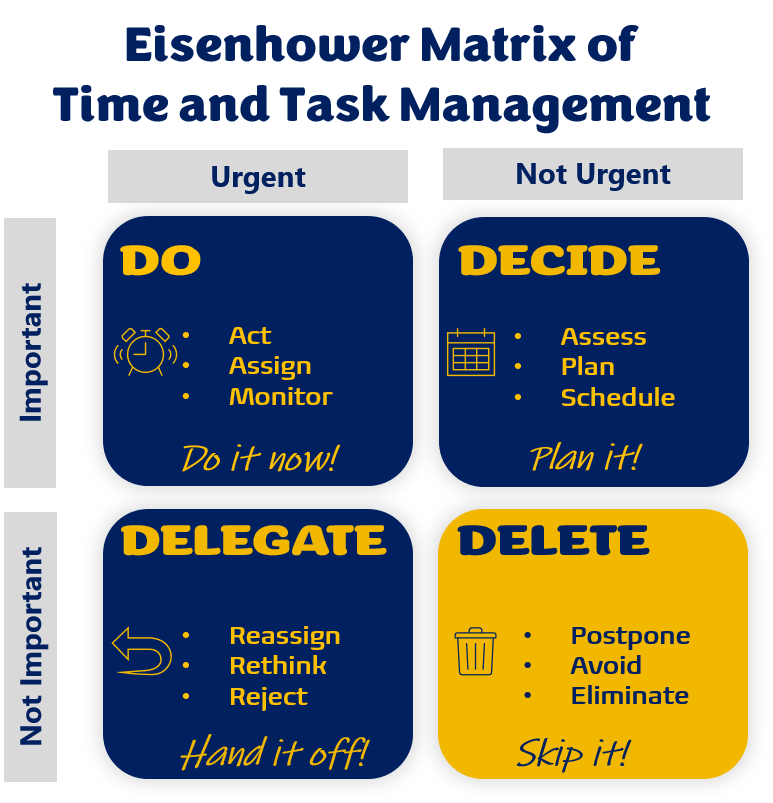
High Urgency, High Importance: Do
Tasks in this quadrant require immediate attention and carry significant negative consequences if delayed or avoided. They should receive the highest priority and become the primary focus until they are completed or stabilized.
Key Descriptors: Crisis, rescue, critical, immediate, act, reactive.
Goal: Reduce the number of tasks in this quadrant over time by planning ahead, protecting time for important work, and preventing avoidable issues from becoming urgent.
Strategies: Prioritize these tasks above all others, assign clear ownership, and reserve uninterrupted time to make meaningful progress. Break larger tasks into manageable steps, address the most time-sensitive work first, and plan ahead so lower urgency tasks do not drift into this quadrant unnecessarily.
Low Urgency, High Importance: Decide
Highly productive people tend to spend most of their time in this quadrant because it supports meaningful progress, long-term success, and greater satisfaction. Covey referred to it as the Quadrant of Quality.
These tasks are closely aligned with strategic goals and long-term objectives. Although they do not require immediate action, they can create significant positive outcomes for the organization, program, or project. Work in this quadrant often requires planning, research, analysis, and strategic or creative thinking, making it essential for sustained progress and success. Spending more time here can improve productivity, reduce future urgency, and support lasting impact.
Key Descriptors: Strategic, proactive, planned, scheduled, analytical, high impact.
Goal: Schedule and protect time for these tasks so steady progress can be made before they become urgent.
Strategies: Assess these tasks to confirm the urgency and importance and decide the next steps to prioritize and assign the task accordingly. Break these tasks into manageable activities or subtasks, assign realistic deadlines, and identify the resources needed to complete them. Review progress regularly, avoid unnecessary delay or postponement, and plan ahead so high-value work does not become urgent.
High Urgency, Low Importance: Delegate
These tasks are time-sensitive and require immediate attention, but they contribute little to strategic goals or objectives. They often support priorities and goals for other teams, do not require specialized expertise, and are routine, recurring, or administrative in nature.
Key Descriptors: Critical, low impact, disruptive, distraction, recurring.
Goal: Reduce the number of tasks in this quadrant and minimize time spent on these tasks by delegating, reassigning, automating, or declining when appropriate.
Strategies: Handle these tasks quickly and avoid letting them distract from meaningful work. Delegate or reassign them to the appropriate team, team members, or partners when possible. For recurring activities, consider automation. For low-impact, trivial requests, decline respectfully with a clear explanation when appropriate.
Low Urgency, Low Importance: Delete
This final quadrant includes tasks that do not require immediate attention and do not meaningfully support strategic goals or objectives. These tasks often create distractions, disrupt focus, and slow progress. When a task adds little value, eliminating it is often the fastest and most effective path to resolution. In some cases, however, data integrity or process requirements may require closing the task as incomplete rather than deleting it outright.
Key Descriptors: Low value, distracting, disruptive, nonessential, low impact.
Goal: Reduce the number of tasks in this quadrant and minimize time spent on them by eliminating, deferring, delegating, automating, or deleting them as appropriate, freeing more time for more high-value, meaningful work.
Strategies: Defer optional, quality-of-life tasks to the backlog until spare time and resources are available. Delegate or reassign required trivial work when appropriate and automate recurring, routine tasks where possible. Avoid, eliminate, or delete tasks that are time-wasting, nonessential, or low impact.
How to Balance the Quadrants to Maximize Productivity
Although the Eisenhower Matrix is primarily a prioritization tool, it also helps teams and managers decide where to focus their time. The Eisenhower Matrix helps teams and managers balance urgency, importance, and priority when identifying, assigning, and tracking work. By clarifying when something is needed (urgency), why it matters (importance), and what should be addressed first (priority), the matrix supports better planning, timing, and focus.
Stephen Covey referred to the Decide Quadrant as the “Quadrant of Quality” because time spent on important, low-urgency work improves performance, effectiveness, and strategic impact. This is where strategic growth connects with tactical planning, prevention, and intentional action. When planning and prioritizing, the Decide Quadrant deserves special attention. Allocating sufficient time and resources to this work helps create meaningful, long-lasting impact and supports sustainable outcomes.
To apply the Eisenhower Matrix effectively and maintain balanced quadrants, follow the steps below:
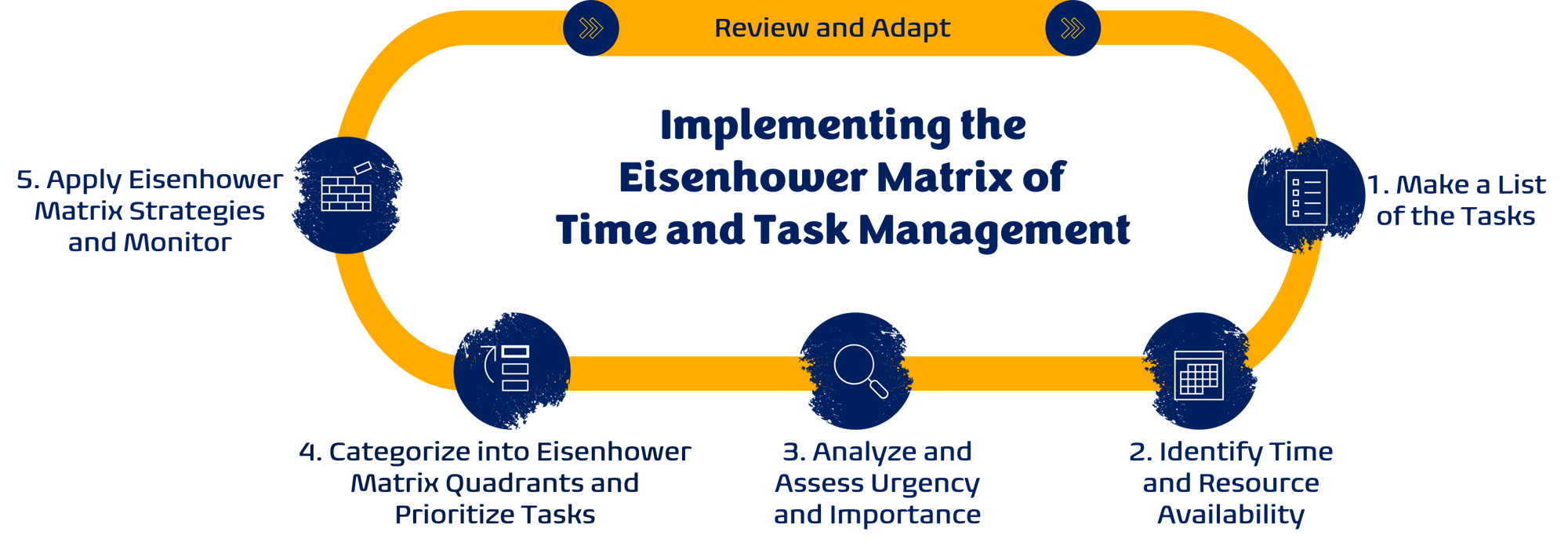
Step 1: Create a Complete Task List
Use a task tracking or visualization tool that fits the needs and available resources, such as Microsoft Excel, Google Sheets, Jira, SharePoint, Microsoft ToDo, Asana, Trello, or Todoist.
Hold brainstorming sessions when team or project tasks are unclear.
Create a comprehensive list that includes short-term, long-term, and administrative tasks.
Step 2: Identify Available Time and Resources
Assess each task, estimate the time and resources required, and document those assumptions clearly.
Compare estimated needs against available time and resources, then note any gaps that may affect prioritization.
Step 3: Assess Urgency and Importance
Engage the appropriate stakeholders to assess the impact on cross-functional teams, internal and external stakeholders, and end users.
Plan important but non-urgent work so progress begins early and continues steadily over time.
When urgency or importance is unclear, break the task into smaller activities or subtasks. Prioritize the parts that are both urgent and important and defer the remainder when appropriate.
Step 4: Categorize Tasks and Set Priorities
Prioritize with clarity and purpose. Eliminate tasks that do not align with strategic goals and objectives or that lack a clear outcome or meaningful impact.
Set clear deadlines, ownership, and expectations for completion.
Resolve priority conflicts by considering importance, urgency, available resources, and dependencies.
Keep each quadrant manageable by limiting the number of tasks to a realistic and feasible amount.
Move low-priority items to the backlog for later analysis and prioritization.
Step 5: Apply the Matrix and Monitor Progress
Reserve focused work blocks for high-priority tasks by minimizing distractions and interruptions, such as pausing email, silencing phones, and blocking time on the calendar.
Use time blocking to make steady progress on high-priority work and prevent low-urgency tasks from becoming urgent.
Add notifications and reminders to help teams stay on track.
Use a Kanban board to visualize tasks and monitor progress.
Use a dashboard to track status, performance metrics, and trends.
Color code urgency, importance, and priority to support quick assessment and shared understanding.
Finally, make reviewing the matrix part of a routine. Revisit the task list periodically to account for and adapt to changing priorities, new work, and shifts in resource availability. Move tasks to the appropriate quadrant as conditions change and adjust actions accordingly.
Difference Between Time Tracking and Time Management
The Eisenhower Matrix is a time management tool, not a time tracking tool. Time management and time tracking are related, but they serve different purposes. Time management is the forward-looking process of planning, prioritizing, and organizing tasks so time is used effectively. It helps improve focus, productivity, and overall work performance. Time tracking, by contrast, is the retrospective process of recording the actual time spent on tasks, often for reporting, billing, payroll, or performance analysis.
When time tracking is required, good time management can make it more accurate and easier to maintain by clarifying what work was planned and when it was expected to occur. Time tracking can also support future planning by providing objective data on the actual time required to complete a task. In this way, time management guides future work, while time tracking provides historical data that can improve future decisions.
Benefits of the Eisenhower Matrix
The Eisenhower Matrix offers a simple, flexible way to improve task management, reduce distractions, and focus time on work that matters most. Some key benefits include:
Clear Prioritization: By sorting tasks by urgency and importance, the matrix helps teams and managers identify high-impact work, avoid low-value activities, and ensure critical tasks are not overlooked.
Adaptability: The matrix can be used across individual-, team-, project-, and program work. It is useful in both high-pressure environments, such as health care, and low-pressure settings, such as schools or administrative teams.
Reduced Stress: Organizing tasks into clear categories makes workload easier to manage. Teams and managers can quickly see what needs immediate attention or what should be scheduled, delegated, or eliminated.
Improved Productivity: Focusing on important work helps teams and managers make better use of their time, reduce unnecessary effort, and create more capacity for meaningful progress.
Better Decision-Making: Evaluating each task by urgency and importance encourages more intentional decisions about time, resources, and tradeoffs.
Stronger Focus and Accountability: The matrix helps prevent procrastination, limit distractions, and keep attention on tasks that support immediate needs and long-term goals.
Easy Implementation: The method is simple to use and does not require special apps, complex tracking systems, or extensive journaling.
Conclusion
At its core, the Eisenhower Matrix is more than a time management tool; it is a way to plan and act based on why a task is needed (importance), when it should be worked on (urgency), and what should be the focus (priority). By separating what is urgent from what is truly important, individuals and teams can move beyond constant reaction and create space for thoughtful planning, meaningful progress, and focus on sustainable progress and lasting impact. The goal is not to eliminate every interruption or complete every task at once, but to build the discipline to focus on the work that matters most. When used consistently, the matrix transforms an overwhelming task list into a clear path forward—helping people work with greater purpose, confidence, and control.
