
Beyond Instinct: A Practical Guide to Better Decision-Making
Is the latest build ready to release—or are the risks still too high? Has the team truly agreed on the baseline MVP, or is everyone working from a different assumption? Should finance fund the next phase, or is it time to sunset the project? Should the product team revive an aging offer, or retire it before it drains more energy? Is the final candidate the right hire, or is it just the easiest decision to make? Beneath every question sits the same pressure: Choose well, choose fast, and live with the consequences. Decision-making is not just a task; it is the engine behind momentum, trust, strategy, and results. When the process is unclear, choices become overwhelming, frustrating, or reactive. But when teams understand how decisions are shaped by influencing elements—like type, culture, approach, and behavior—they can move from confusion to clarity and make choices that are not only faster but smarter.
This article explores what really lies beneath the surface of every important decision: Attitude, behavior, engagement, culture, and approach. Decisions can either sharpen judgment or quietly derail it. We will look at the major types of decisions organizations face, the factors that influence decision quality, and how a clear, practical decision-making process can help assess effectively and act with greater confidence. Most importantly, it shows why better decisions are not the result of luck or instinct alone—they come from informed, intentional, and accountable choices made through a process people understand and trust.
What Is a Decision?
A decision is a conclusion or choice made after weighing different options, facts, and possible outcomes. It represents the act of answering a question or committing to a specific course of action. More broadly, decision-making is a cognitive process through which people evaluate alternatives and select a path forward. In this sense, decisions are the product of reasoning, judgment, and intentional choice.
A decision is not only a response to the past; it can also influence, shape, and change the future. Decisions are shaped by the collective knowledge, foresight, and actions that a team or manager is prepared to take. Because decisions are often made with incomplete information, outcomes are not guaranteed, and actions may not unfold as intended, effective decision-making is more complex than it may initially appear.
When a situation requires a decision, it calls for collecting and analyzing data, assessing risks and uncertainties, exploring alternatives, considering potential impacts and outcomes, reaching a conclusion, and committing to action. This is the essence of the decision-making process. A structured approach helps individuals and teams make more deliberate, thoughtful decisions by evaluating relevant information, comparing alternatives, and selecting the most suitable option through the process of elimination.
What Factors Influence the Decision?
Decision-making is influenced by a combination of factors, including conditions, responsibilities, values, information, people, and expected outcomes. These factors shape how a decision is understood, how much time and analysis it requires, who should be involved, and what consequences need to be considered before action is taken. Understanding these influences helps decision makers choose a more balanced, appropriate, and effective course of action. For example, deciding whether to release a product is often more complex than choosing whether to use blue or gray in a user interface. The list below summarizes the main factors:
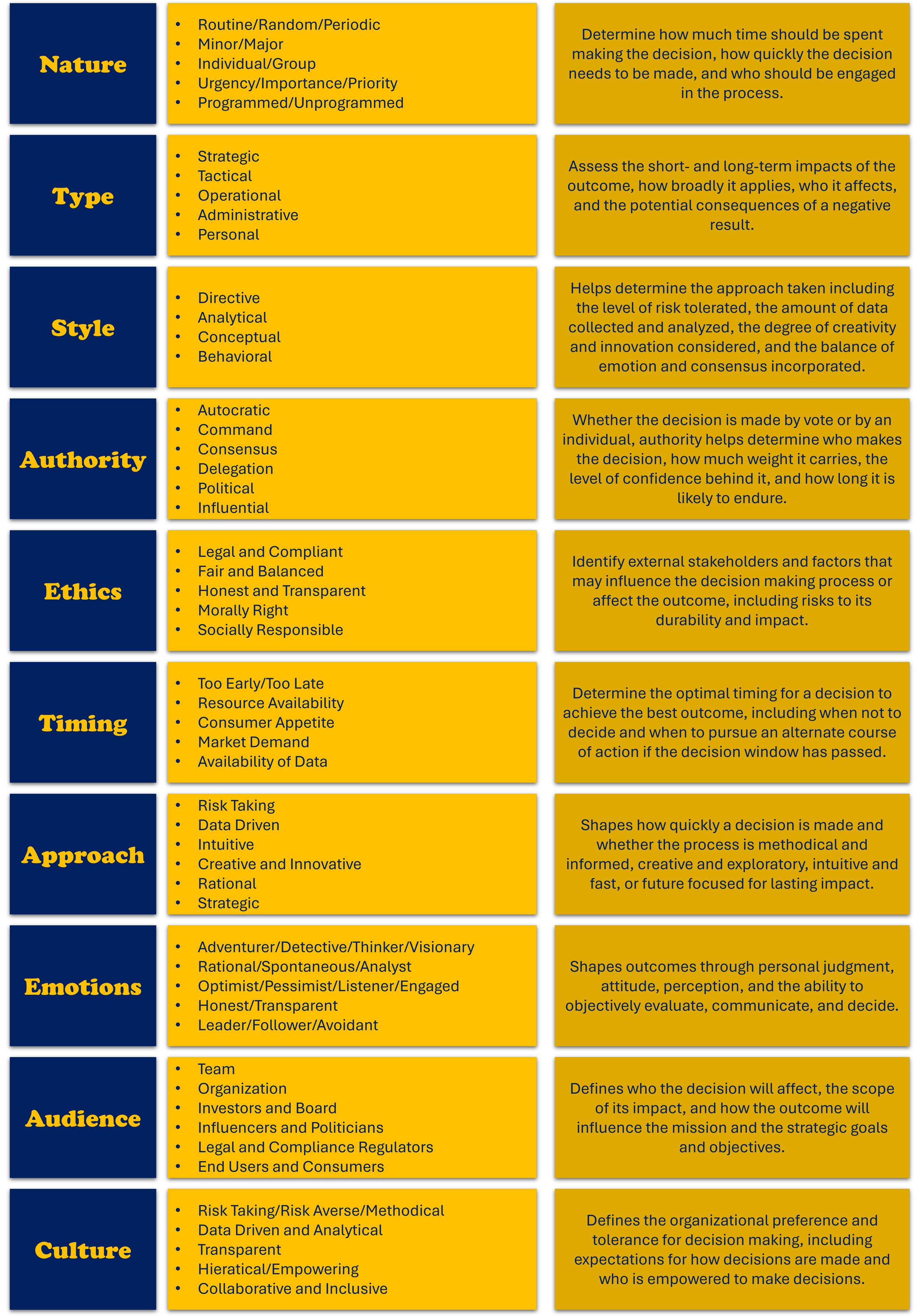
Decision-Making Process
Decision-making varies by the type and level of impact involved. Strategic decisions shape the direction, priorities, and long-term alignment of the organization. Operational decisions influence how projects, programs, or services are delivered and whether intended outcomes are achieved. Administrative decisions are typically routine, recurring, and low impact, but they still require consistency and sound judgment. Across all decision types, the baseline process remains the same: Define the event or issue, gather and analyze relevant information, assess risks and consequences, consider available options, engage the appropriate stakeholders, and make a decision that supports the desired outcome. The difference is the depth of analysis, the amount of time and resources invested, and the level of stakeholder involvement required. Following the steps below helps ensure that decisions are thoughtful, well-informed, and aligned with the significance of the issue being addressed:
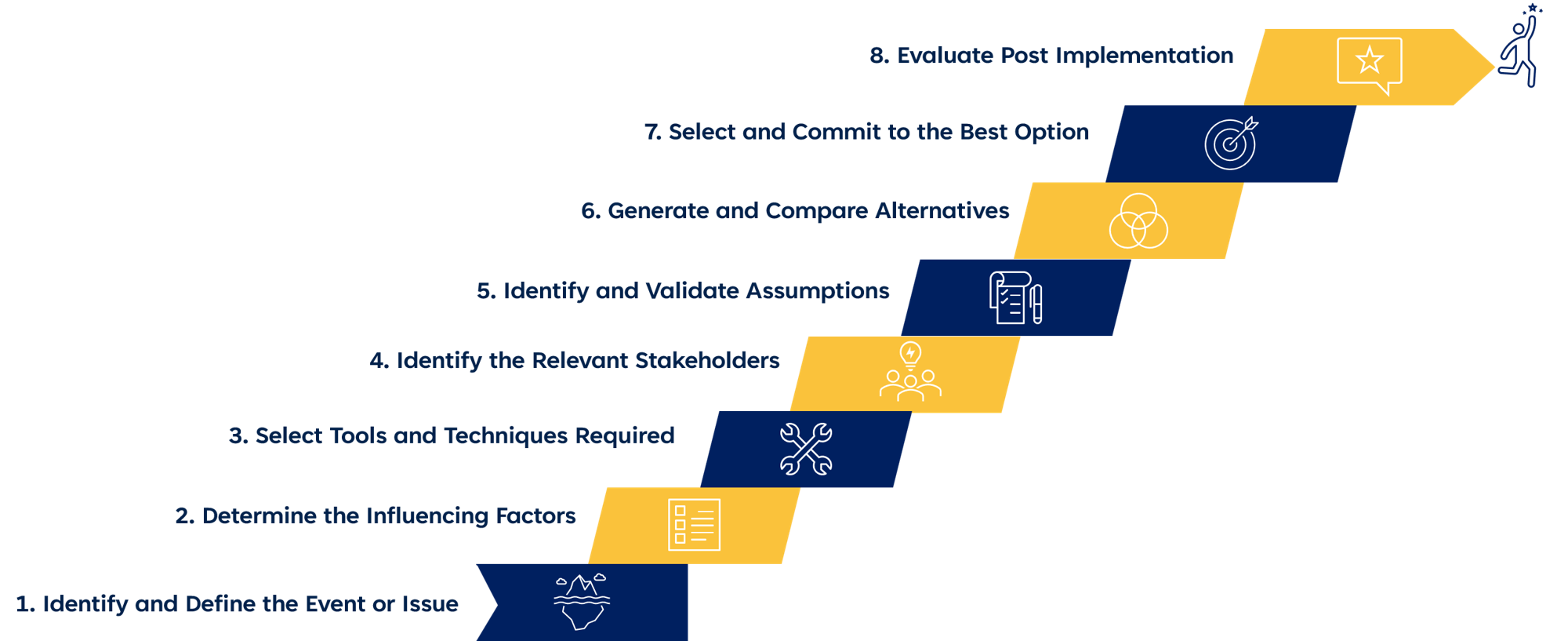
Step 1: Identify and Define the Event or Issue
Begin by carefully analyzing and clearly defining the problem, event, or issue that requires a decision. Ensure that everyone involved in, or affected by, the outcome has a shared understanding of what needs to be resolved. Clarify the circumstances surrounding the decision, the desired objectives, and the goals to achieve.
Use the “5 Whys” or “Problem Tree Analysis” techniques, or a similar method, to ensure the issue is described clearly, concisely, and comprehensively.
Apply a SWOT analysis, or a similar framework, to assess the circumstances surrounding the decision, including strengths, weaknesses, opportunities, and threats.
Use the SMART framework to confirm that the objectives are specific, measurable, attainable, relevant, and time-bound, and determine whether the decision is appropriate and worth pursuing.
Step 2: Determine the Influencing Factors
Review the factors that may influence both the decision and the decision-making process. This includes assessing the urgency and importance of the issue, the scope and breadth of impact, the type of decision being made, and the level of engagement needed from stakeholders or other affected parties.
Use the “6 Thinking Hats” technique to compare possible approaches and determine whether the decision should be rational, data-driven, creative, intuitive, or strategic.
Use the Eisenhower Matrix to prioritize decisions based on urgency and importance, especially when multiple decisions compete for attention.
Use the SAILBOAT technique to identify obstacles that may slow progress, the factors that may help move the team forward, and the ways authority, emotions, culture, or team dynamics may influence the decision.
Step 3: Select Tools and Techniques Required
Used at the right time, the right tools and techniques keep the process focused, efficient, and aligned with the purpose of the decision. The right tools and techniques help assess the situation, analyze information, identify root causes, evaluate risks, compare options, and engage key stakeholders. Tools and techniques are most effective when selected to fit the problem, decision type, and desired outcome. Choosing too many tools, or tools that do not fit the context, can hinder progress and create confusion. Select the relevant and appropriate tools and techniques based on the complexity and urgency of the issue, available information and resources, stakeholder involvement, and level of analysis needed.
Explore www.ganttpost.com for practical guidance, ready-to-use templates, and resources to support problem-solving, decision-making, prioritization, risk management, and more.
Step 4: Identify Relevant Stakeholders
Decision-making often involves more than one person. Even when a decision is made by a single decision maker, it may still require input from or affect a broader group. Identifying the required stakeholders, understanding who may volunteer input, and assessing the level of influence and impact of each stakeholder helps ensure the right people are engaged at the right time. This approach supports better decisions while reducing unnecessary noise or competing input that could distract from the desired outcome. As stakeholders are assessed and identified, consider mapping the technical, political, and cultural factors that may influence the decision. Engage colleagues with diverse skills, perspectives, and experience levels to support a more informed and well-rounded decision.
Use the Stakeholder Influence/Interest Matrix to determine the level of engagement and influence from each stakeholder, with particular focus on actively involving those who have both high interest and high influence in the decision.
Use the SEAM technique, or a similar stakeholder assessment method, to evaluate stakeholder engagement and compare current and desired levels of influence, interest, and impact of each stakeholder.
Use the RACI Matrix to define stakeholder roles and responsibilities, including who is responsible for actions, responses, and decisions.
Step 5: Identify and Validate Assumptions
Begin by identifying the key assumptions that may influence the decision, including their source, rationale, and level of supporting evidence. Assumptions should be identified, challenged, and validated to reveal unstated beliefs, cognitive blind spots, hidden risks, and areas of uncertainty. Where possible, validate assumptions through relevant historical data, forecasted trends, pattern analysis, and alternative scenarios. This helps understand how each assumption affects projected outcomes and whether the decision is grounded in evidence rather than bias or unsupported expectations.
Use an Assumption Importance/Certainty Matrix, or a similar tool, to assess the priority and confidence level of each assumption.
Use the PDCA cycle to test, review, and refine assumptions through an iterative process of planning, validating, checking results, and adjusting as needed.
Use the Pareto technique, or a similar method, to identify the primary causes that contribute most significantly to the problem or outcome.
Use Six Sigma, or a similar data analysis methodology, to evaluate the reliability, variation, and statistical significance of the available data.
Step 6: Generate and Compare Alternatives
After assumptions and supporting data have been reviewed, identify a range of practical options that could address the problem or opportunity. Each alternative should be relevant, feasible, realistic, and aligned with the desired outcome. Compare the options using objective criteria, such as expected impact, benefits, resource requirements, urgency, risk, and strategic importance. This helps ensure the final decision is based on evidence and balanced judgment rather than preference or convenience.
Use the SKS method, or a similar approach, to identify which negative attributes should stop, which best attributes should be kept, and which new attributes should be introduced.
Use MoSCoW analysis, or a similar prioritization method, to distinguish non-negotiable requirements from negotiable preferences when comparing alternatives.
Use the SMART framework to confirm that each option is specific, measurable, attainable, relevant, and time-bound, allowing for a fair and consistent comparison.
Step 7: Select, Commit to, and Act on the Best Option
After the alternatives have been evaluated, select the option that best aligns with the desired outcome, expected impact, available resources, and overall benefit. The choice should be supported by clear rationale and, when needed, shared agreement among key stakeholders. A decision is only effective when it is followed by commitment and action. Once the option is selected, confirm ownership, allocate the necessary resources, define next steps, and communicate the decision to the appropriate audiences so implementation can move forward with clarity and accountability.
Use tools, such as a Pros/Cons List, Impact/Effort Matrix, or Cost/Benefit Matrix, to confirm the value of each option, feasibility, return on investment, and level of effort.
Use Decision Tree Analysis to evaluate possible outcomes, eliminate weaker options, and support selection of the strongest alternative.
Use the RACI Matrix to clarify ownership, roles, and responsibilities, including who is responsible for action, accountability, consultation, communication, and monitoring progress.
Step 8: Evaluate Post-Implementation Results
A decision is not complete once action is assigned. Review the quality of the decision, the effectiveness of implementation, and the impact of the outcome. This evaluation should not occur only at the end; it should take place periodically so results can be monitored, lessons can be captured, and adjustments can be made as needed. Use these insights to course-correct the current plan and strengthen future decision-making.
Use Cause and Effect analysis to identify the root causes of failures, gaps, or unintended outcomes.
Use the “What Went Well” technique to identify effective practices, practices that did not work as intended, and areas for improvement.
Use the “Liked, Learned, Lacked, Longed For” method to capture what contributed positively, what was learned, what was missing, and what may be needed in the future.
Individual vs. Group Decisions
Decisions may be made by an individual or by a group, depending on the issue, urgency, complexity, available expertise, and level of stakeholder commitment required. Individual decisions are useful when speed, confidentiality, clear accountability, or specialized expertise is needed. Group decisions are valuable when the issue is complex, the impact is broad, information is distributed across stakeholders, or successful implementation depends on shared understanding and consensus. Understanding when and how to use either approach is important because the decision method can influence the quality of the outcome, the speed of execution, stakeholder trust, and accountability for follow-through.
For group decisions, the method used to reach agreement should match the complexity, urgency, impact, and strategic importance of the decision. Teams may rely on voting, consensus building, delegation, or leader-led decision-making, depending on the context. Each approach has advantages and trade-offs, so it is important to consider how the method will affect speed, stakeholder commitment, accountability, and the quality of the final outcome. The overview below summarizes the most common group decision-making approaches:
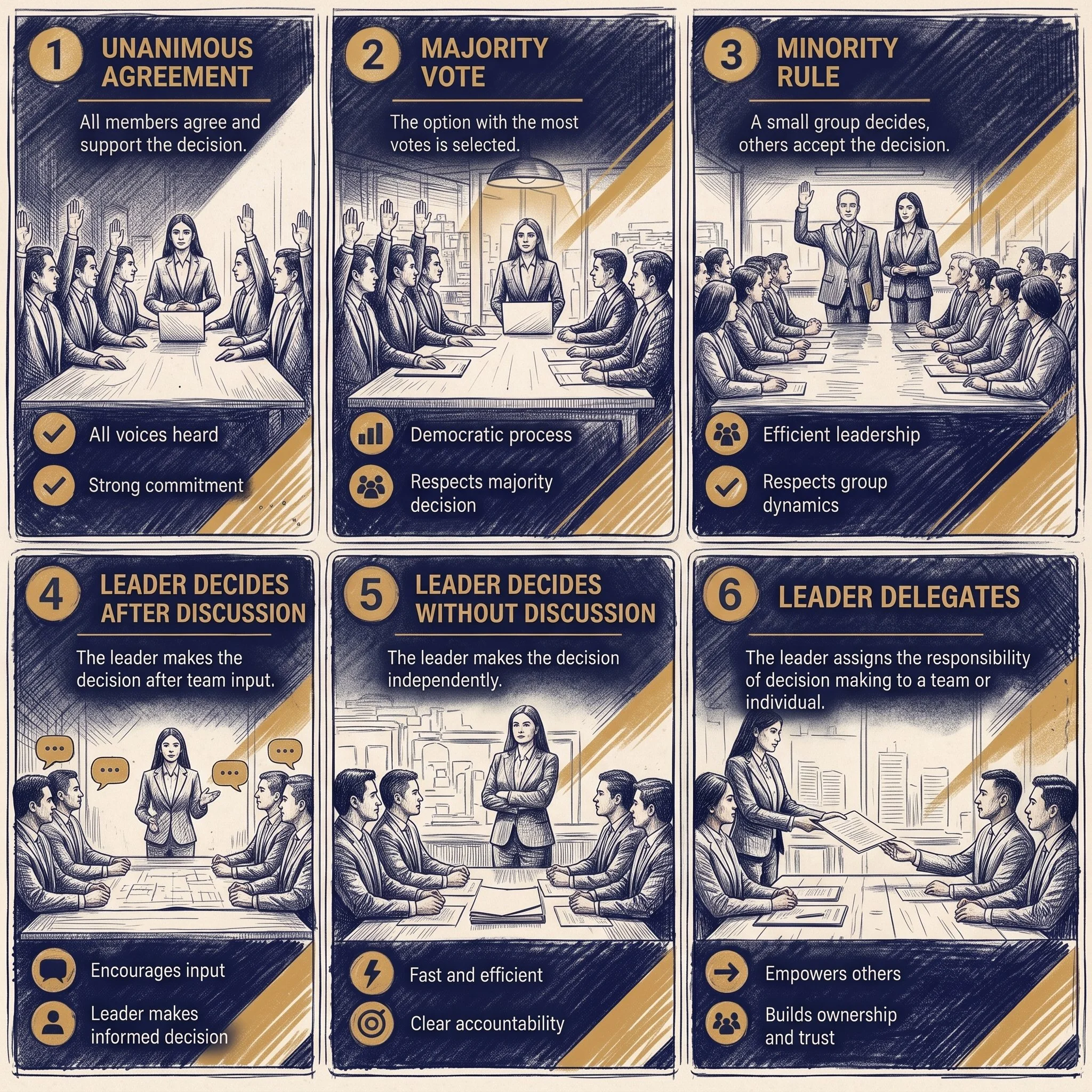
Unanimous: All members agree and support the decision. This method is most beneficial for high-impact decisions that require strong alignment, trust, and shared commitment. Teams choose it when implementation depends on broad support and endorsement and when disagreement could create risk or resistance. From an accountability standpoint, responsibility is shared across the group because everyone has agreed to the outcome.
Pros: Strong alignment, commitment, and trust.
Cons: Can take significant time and may be difficult when opinions differ.
Majority: The option supported by most participants is selected, either by an absolute majority or by a relative majority. This method is most beneficial when a timely decision is needed, and the group has enough information to choose among acceptable options. Teams choose it because it is practical, efficient, and gives each participant a voice. Accountability is shared by the group, though leaders should acknowledge and respond to dissenting views to maintain trust and commitment.
Pros: Efficient, democratic, and practical for groups.
Cons: May leave some stakeholders feeling unheard or less committed.
Minority: A smaller group or subset makes the decision. This method is most beneficial when expertise is concentrated among a few people or when the full group does not need to be involved. Teams choose it to move faster while relying on informed judgment. Accountability rests primarily with the selected subgroup, so their authority, rationale, and communication responsibilities should be clear.
Pros: Faster and useful when expertise is concentrated.
Cons: May limit broader input and reduce ownership.
Leader After Discussion: The leader gathers input before making the final decision. This method is most beneficial when stakeholders' perspectives are important, but one person must remain accountable for the final call. Teams choose it to balance collaboration with speed and clarity. Accountability remains with the leader, while contributors are responsible for providing relevant input and supporting implementation once the decision is made.
Pros: Balances consultation with clear accountability.
Cons: May create frustration if input is not visibly considered.
Leader Without Discussion: The leader decides independently. This method is most beneficial in urgent, confidential, low-complexity, or authority-driven situations where discussion is not practical or necessary. Teams choose it when speed, discretion, or clear direction is more important than broad input. Accountability sits directly with the leader, who should communicate the decision clearly and explain the rationale when appropriate.
Pros: Fast, clear, and useful in urgent or confidential situations.
Cons: May reduce buy-in and overlook important perspectives.
Delegate: The decision is assigned to another person or group. This method is most beneficial when the decision owner has the expertise, context, or proximity to make an informed choice. Teams choose it to empower others to resolve and allow leaders to focus on higher-priority issues. Accountability transfers to the delegate with clearly defined authority, expectations, timelines, and escalation points.
Pros: Empowers others, uses specialized expertise, and supports development.
Cons: Requires clear authority, expectations, and follow-up to avoid misalignment.
Elements of Good Decision-Making
Good decision-making depends on essential elements that support informed, unbiased, objective, and impactful choices. These elements are important because they help individuals and teams move beyond assumptions, preferences, or urgency-driven reactions and instead make choices that are evidence-based, strategically aligned, and operationally practical. When applied consistently, they improve the quality of decisions, strengthen accountability, increase stakeholders' confidence, reduce avoidable risk, and support outcomes that are both effective and sustainable. Some key elements include:
Frame the Problem or Opportunity Correctly: Clearly define what needs to be resolved, why it matters, and what is in scope before moving to solutions.
Choose the Right Decision Approach: Match the decision style, level of participation, and tool set to the situation, urgency, and complexity.
Set Clear Objectives: Establish the desired outcome, success measures, and decision criteria so options can be evaluated consistently.
Use Reliable and Relevant Information: Gather accurate data, facts, and evidence from credible sources to support informed judgment.
Align With Vision, Values, and Strategy: Ensure the decision supports organizational priorities, core values, and strategic direction.
Consider Realistic Alternatives: Identify feasible options and compare them against the decision criteria, expected benefits, and constraints.
Consider Strategic Impact and Sustainability: Evaluate how the decision may affect future operations, stakeholders, and organizational resilience.
Account for Available Resources: Consider budget, time, people, tools, and capacity so the decision is realistic and executable.
Manage Risk and Uncertainty: Identify risks and assumptions, potential consequences, and mitigation actions before selecting a path forward.
Engage the Right Stakeholders: Involve the people who are affected by, accountable for, or able to improve the quality of the decision.
Empower the Right Experts: Give subject matter experts the authority, context, and support needed to contribute effectively.
Encourage Diverse Perspectives: Create safe space for open discussion, constructive challenge, and different viewpoints to reduce blind spots.
Recognize and Reduce Cognitive Bias: Challenge assumptions, test conclusions, and seek disconfirming evidence to improve objectivity.
Reflect Organizational Culture: Consider how the decision aligns with accepted ways of working, shared expectations, and the behaviors the organization wants to reinforce.
Balance Rigor With Practicality: Avoid unnecessary perfectionism by making the best possible decision with the information, time, and resources available.
Commit to Action: Define ownership, next steps, and timelines and follow-through expectations so the decision moves into execution.
Review Results Transparently: Discuss outcomes openly, validate whether the decision achieved its purpose, and identify lessons learned.
Practice Mindfulness and Emotional Intelligence: Stay aware of emotions, interpersonal dynamics, and communication patterns that may influence judgment or collaboration.
Elements to Avoid During Decision-Making
Effective decision-making requires recognizing the habits, conditions, and behaviors that can weaken judgment. Poor problem framing, unreliable information, misplaced urgency, untested assumptions, bias, and unbalanced group dynamics can result in incomplete analysis, misaligned choices, delayed action, and weak accountability. Identifying these issues early is critical because most decision-making problems can be corrected before they lead to costly outcomes. To course-correct, decision makers should pause, clarify the issue, challenge assumptions, verify information, involve the right expertise, test for bias, and realign the decision with organizational goals, values, and available evidence. Some examples of elements that can weaken judgment and negatively impact decisions are:
Inaccurate or Ambiguous Problem Statement: A poorly defined issue can cause teams to solve the wrong problem, overlook root causes, or select options that do not address the actual need.
Misalignment With Strategic Goals: Decisions that do not support strategic priorities can waste resources, create competing priorities, and reduce overall effectiveness.
Misjudging Urgency and Importance: Treating every decision as urgent can create pressure and reactivity, while underestimating importance can delay action on issues that require timely attention.
Unreliable or Irrelevant Information: Data of poor quality or that is unrelated can create false confidence and lead to decisions that are not supported by the actual situation.
Untested Assumptions: Unverified beliefs can distort analysis, hide uncertainty, and lead decision makers to act on what they believe to be true rather than what the evidence supports.
Unqualified or Misaligned Experts: Relying on people who lack credibility, experience, independence, or context can weaken confidence in both the decision and the evidence behind it.
Missing Key Expertise: Excluding subject matter experts can leave important risks, constraints, dependencies, or technical realities unaddressed.
Biased Information: Information that favors one viewpoint can limit objectivity and lead to incomplete or misleading conclusions.
Confirmation Bias: Seeking only information that supports existing beliefs can prevent teams from recognizing risks, alternatives, or evidence that challenges the preferred option.
Misapplied Tools and Techniques: Using tools that do not fit the decision context can overcomplicate the process, produce misleading comparisons, or cause one to overlook key risks.
Wrong Decision Type or Approach: A mismatch between the decision method and the situation can slow progress, reduce endorsement and support, create confusion around authority, and weaken accountability.
Misalignment With Culture or Values: Decisions that conflict with organizational values can reduce trust, weaken adoption, and create stakeholder resistance.
Overconfidence: Excessive confidence in knowledge, judgment, or the ability to predict uncertainty can narrow analysis and lead to underestimated risks or overlooked alternatives.
Groupthink: When the desire for harmony discourages challenge, teams may suppress dissent, overlook stronger options, and reach weaker decisions.
Excessive Cohesion: Strong group connection can support cooperation, but when it discourages independent thinking or constructive disagreement, it can reduce decision quality, especially in larger groups or under dominant leadership.
Avoiding Decision Fatigue
Decision fatigue occurs when repeated or complex decisions drain mental energy, making it harder to think clearly, weigh options, and choose well. It is real because every decision requires attention, judgment, and self-control; over time, that cognitive load can reduce focus and lead to rushed choices, avoidance, overreliance on defaults, or analysis paralysis. For decision makers, this can result in low-quality decisions, delayed action, reduced confidence, and unnecessary stress. Avoiding decision fatigue helps preserve mental capacity for the decisions that matter most and supports better judgment, faster execution, and more consistent outcomes. Here are some ways to avoid decision fatigue:
Automate or delegate routine administrative decisions so leaders can preserve time and attention for higher-value choices.
Delegate decisions that have limited impact on strategic or program objectives to the people closest to the work.
Remove decisions that are neither important nor urgent to reduce unnecessary cognitive load.
Time block urgent, important, or recurring decisions so they are handled intentionally rather than reactively.
Accept a good, timely decision when perfection would add little value and create delay.
Plan important but non-urgent decisions in advance and make progress on them in smaller, manageable steps.
Use tools and techniques that fit the decision context and avoid overanalyzing when enough information is available.
Use group decision-making for complex, important issues when time allows for input, alignment, and shared ownership.
Assign clear deadlines to important, high-priority decisions to prevent delays and maintain momentum.
Refer to past decisions and their outcomes to guide similar choices and avoid restarting the analysis from scratch.
Limit alternatives analysis to a manageable number of realistic options to reduce overload and support timely action.
Document and share decisions, rationale, owners, and next steps so teams do not have to revisit the same decision repeatedly.
Conclusion
Good decision-making begins with understanding what a decision really is: A deliberate choice that shapes action and outcomes. From there, the quality of that choice depends on how well the issue is defined, which factors influence it, what process is used, who is involved, and how assumptions, alternatives, risks, and resources are evaluated.
The decision-making process outlines how to clarify the problem, select the right tools, engage the right stakeholders, compare realistic options, commit to action, and review results. Just as important, strong decisions require awareness of the human elements that shape judgment, including culture, bias, group dynamics, emotional intelligence, and decision fatigue.
When these elements are applied intentionally, decision-making becomes clearer, faster, and more accountable. Better decisions build stronger projects, reduce avoidable risk, strengthen trust, and create momentum from uncertainty to action.
