
From Mystery to Mastery: Demystifying Transformation With RBM
Imagine launching a product that fulfills every technical specification, passes all quality checks, and yet, upon release, fails to spark interest or enthusiasm among customers. This scenario is all too familiar in the current marketplace, where the adage “if you build it, they’ll come” no longer guarantees success. Modern consumers are selective—empowered by a wide array of options—and product managers often fail because they neglect the critical link between what they produce, the results they achieve, and the influence they create—known respectively as output, outcome, and impact.
To thrive, organizations must be purposeful in selecting the goods and services they offer. It is no longer enough to simply produce; offerings must possess unique differentiators and, ideally, disrupt the status quo. This demands strategic vision and an operational framework that maximizes efficiency—leveraging the right inputs and activities to generate not only desired outputs, but also meaningful outcomes and lasting impact. Such a holistic approach is essential for achieving maximum value and profitability.
So, how does an organization achieve this? It starts by gaining a thorough understanding of the connection between output, outcome, and impact. This also means identifying the specific resources and actions needed at each stage and continuously evaluating how these efforts align with broader goals. By cultivating this strategic awareness, organizations position themselves to meet evolving customer needs, deliver genuine value, and create lasting satisfaction. In the end, success hinges not just on what is built, but also on the difference it makes and the legacy it leaves behind.
Results-Based Management (RBM) stands as a transformative framework that enables organizations to clearly define their intended impact and outcomes, then strategically align these goals with the necessary outputs, activities, and inputs. By adopting this methodology, organizations gain the ability to move beyond mere production—enabling purposeful action, measurable progress, and lasting influence. This article breaks down the essentials of RBM, highlights the advantages of embracing this methodology, and demonstrates how it can be leveraged to deliver meaningful, measurable results.
What is Results-Based Management?
RBM, as its name implies, is an effective method for providing goods and services in a purposeful way that yields meaningful results and enhances positive impact. This transformative strategy is changing how organizations operate by focusing on clear, measurable, and impactful results rather than simply tracking activity completion. RBM defines clear goals, measures progress, and uses data to make informed decisions.
'Results' in the context of RBM refers to intended changes or effects brought about by the use of inputs and completion of activities—encompassing outputs, outcomes, and impacts. By focusing on results, RBM helps boost performance and supports the achievement of strategic objectives.
In an agile environment, RBM enables organizations to enhance effectiveness and efficiency by continuously learning from both successes and failures. By promoting iterative adaptive strategies and fostering a culture of empirical process, RBM becomes a key instrument for ensuring organizations not only make a meaningful impact but also consistently advance toward fulfilling the mission.
RBM is most effective when integrated with the Theory of Change and Results Chain methodologies for planning and implementation. The Theory of Change framework helps clarify the overarching vision, identify key assumptions, and recognize influential factors, and the Results Chain visually traces the causal pathway from input to impact, ensuring each step is linked and purposeful. Additionally, adopting SMART metrics enables active monitoring and proactive adjustment, thereby driving improved outcomes and maximizing positive impact in RBM. When applied effectively, RBM can offer the following key benefits:
Enhanced Strategic Focus: By developing a unified vision and establishing shared objectives, teams are better able to focus and accomplish their goals effectively.
Informed Decision-Making: Organizations can make smarter decisions by regularly monitoring progress and evaluating outcomes. With dependable data, teams can quickly refine strategies and actions, enhancing the likelihood of achieving their objectives.
Increased Accountability: By consistently monitoring and evaluating progress, organizations are better equipped to hold teams accountable for achieving impactful and meaningful results.
Optimized Resource Allocation: When organizations focus on outcomes and impacts and give priority to the essential inputs and actions that produce those results, they can use their time, funds, and resources more efficiently.
Stakeholder Engagement and Ownership: By encouraging participation, collaboration, and inclusivity, a sense of ownership is built, which helps ensure initiatives are supported and their results are long-lasting.
Promotion of Innovation and Creativity: Using an iterative empirical design process and an incremental agile delivery method inspires organizations to explore innovative ideas and creative solutions.
Understanding the Core Elements of RBM
In order to positively influence outcomes and make a long-lasting impact, it is crucial for organizations to understand the building blocks of the RBM framework: Inputs, Activities, Outputs, Outcomes, and Impacts.
While these terms are frequently used, they often suffer from inconsistent definitions and misinterpretation across different entities. Most organizations understand these elements independently; however, many struggle to define them consistently and establish the necessary links between them. A shared understanding of the elements and their interplay is essential for enhanced, purposeful product design and ensures that every action aligns with the mission and broader objectives.
Furthermore, clearly defining these elements allows an organization to establish measurable goals and indicators. This framework supports continuous evaluation and adjustment, which is vital for maximizing both efficiency and value.
Inputs (What You Invest): Inputs are the essential elements required before a project can move into the execution or implementation phase. They provide the foundational resources needed to achieve the intended results. While financial and human resources are the most obvious, inputs also include strategic elements (such as mission, vision, goals, and objectives), Subject Matter Experts (like industry, legal, and regulatory specialists or social media influencers), material resources (vehicles, equipment, supplies), technical resources (methodologies, templates, data, software), and relational resources (such as partnerships, consultants, and contractors).
Activities (What You Do): Activities refer to the specific actions or work performed to meet the goals and objectives. Essentially, activities are verbs—such as analyzing, assessing, building, testing, conducting, establishing, training, or delivering. Activities encompass processes, events, workshops, workflows, tasks, and other operational steps.
NOTE: It is important to distinguish between inputs and activities, as they are often mistakenly used interchangeably. Inputs are the resources or assets required—what is invested in the project. In contrast, activities are the actions undertaken to utilize these resources. For instance, collecting data is an activity, whereas the historical data itself is an input. Similarly, sourcing and hiring bakers is an activity, while the bakers themselves are inputs.
Output (What You Produce): Outputs validate that implementation is complete. They are the direct products of consumed inputs and completed activities and may be tangible or intangible, ranging from goods, services, innovations, systems, applications, solutions, results, reports, and data. Clearly defining and measuring outputs is vital, as they reveal the immediate progress made toward broader goals and objectives. Their measurability enables effective evaluation and ongoing improvement.
NOTE: It is essential to clearly distinguish between activities and outputs, as these terms are often misused interchangeably. Activities refer to the tasks or work carried out to produce an output, while outputs are the actual products or results of those efforts. For example, performing tests is an activity, but the test report is the output; baking is an activity, and the finished cake is the output.
Outcome (The Immediate Effect): Outcomes are the changes or benefits that stem directly from the outputs. Outcomes are dynamic and serve as clear indicators of how effective the outputs have been. They often manifest as shifts in behavior, practices, or performance—crucial milestones on the path to achieving broader impact. In essence, outcomes are best described by adverbs, such as improved, enhanced, increased, sustained, or aligned, which capture the nature and extent of the realized change.
Outcomes signify real transformation, marking the point in project management where focus shifts from simply tracking activities and counting output to evaluating meaningful progress. To accurately measure outcomes, it is essential to use SMART metrics. These metrics should be assessed after the output has been utilized, not immediately upon its delivery, ensuring that the evaluation captures the true effect of the change and behavior (outcome).
Impact (The Consequence): Impact refers to the enduring, long-term effect that outputs and outcomes have across the entire organization. Because impact develops gradually over a long period and is shaped by numerous influences, it is often challenging to pinpoint precisely how a specific outcome contributes to the impact. In certain instances, the effects of the change may not be apparent for several years post-implementation; notable examples include decreases in child mortality rates, a reduction in poverty, or slowing climate change. Nevertheless, focusing on impact ensures the change strives for meaningful transformation rather than simply accomplishing tasks. Examples of impact include enhancing financial performance (higher revenue or profits), gaining a competitive edge (such as expanding market share or technological innovation), improving customer perceptions (through retention, growth, and satisfaction), and enriching employee experience (including retention, engagement, and performance).
NOTE: Clearly distinguishing between outcomes and impacts requires careful attention to both the scale and the time needed for change to manifest. Impacts are generally wider in scope and more enduring than outcomes, often taking longer to become evident. Grasping this difference is essential for establishing realistic objectives and managing expectations in projects.
Theory of Change
Theory of Change is a strategic framework that guides the planning, implementation, and evaluation of change initiatives. Like RBM, it clarifies how and why desired outcomes are expected to occur by mapping the necessary inputs, activities, and resulting outputs. This framework is used to carefully assess what is needed for meaningful change, helping to create focused outcomes and lasting impacts.
One of its primary advantages is the clarity and focus it brings to change efforts. The Theory of Change encourages stakeholders to articulate assumptions, define measurable indicators, and align strategies with intended outcomes. This structured approach facilitates monitoring progress, making necessary adjustments, and maintaining accountability. It also promotes collaboration by engaging diverse perspectives in the planning process, leading to more effective and sustainable solutions. As shown in the figure below, the stages of the Theory of Change are not linear; rather, they form a cyclical, iterative process. This approach encourages ongoing evaluation of assumptions and external influences that may affect outcomes and facilitates the integration of insights gained into subsequent planning activities.
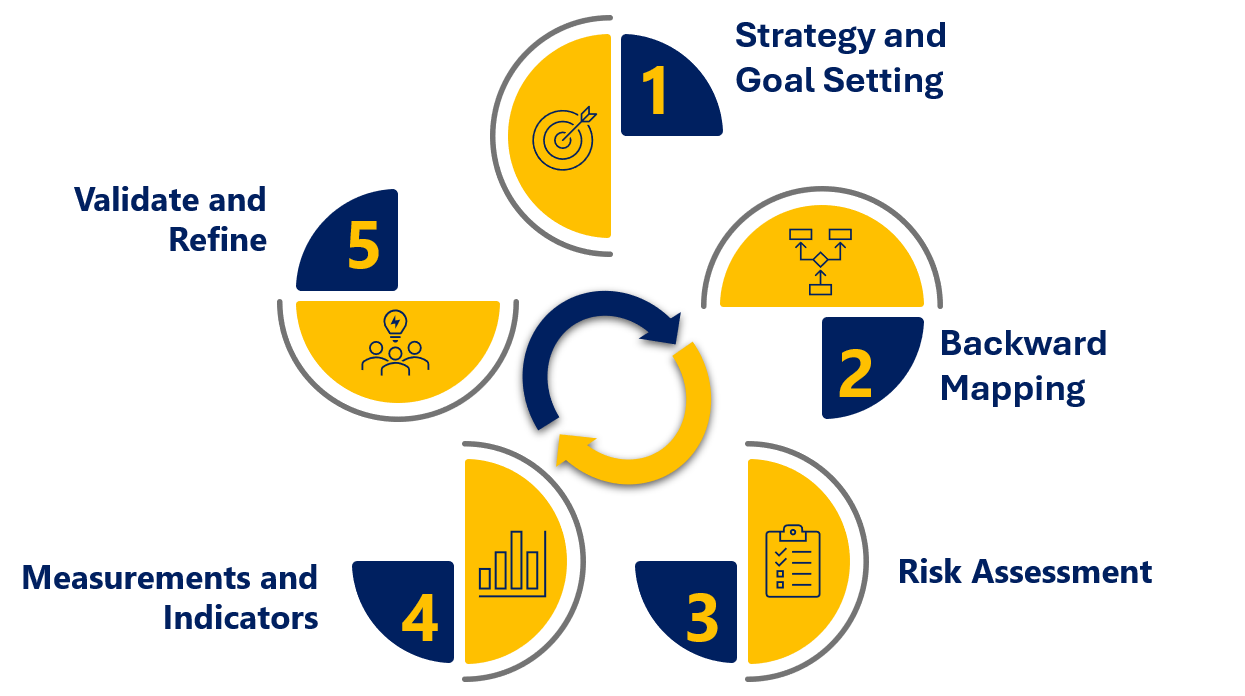
Figure 1: Theory of Change
Theory of Change is a cyclical iterative discipline designed to improve inputs and activities and strengthen output over time. When applying Theory of Change, follow the steps below with the expectation that they will be revisited and refined as new insights emerge.
Step 1: Strategy and Goal Setting: Begin by defining clear strategic goals and objectives. Collaborate with stakeholders to incorporate shared ambitions and desires.
Step 2: Backward Mapping: Begin by identifying the intended impact, then trace back to determine the required outcomes, outputs, activities, and inputs. Explicitly show how each element leads to the previous, establishing a clear "pathway of change" that supports the ultimate goals.
Step 3: Risk Assessment: Identify key assumptions and external variables that may affect outcomes and impact. Evaluate each factor based on its potential effect on success and the probability of occurrence. This risk analysis step supports the development of monitoring strategies and enables proactive adjustments to mitigate identified risks.
Assumptions: These are the underlying beliefs and conditions that must hold true for the Theory of Change to be effective. Assumptions clarify how, why, or under what circumstances change is anticipated. They can also be reframed as potential risks: Factors or events that could prevent the desired change from occurring.
External Factors: Elements or conditions that originate outside an organization and may influence the planned results but typically fall beyond the direct control of the organization.
Step 4: Measurements and Indicators: For each element, specify measurable indicators, data sources, collection methods, and frequency. Ensure indicators are SMART and include disaggregation for a detailed analysis.
Step 5: Validate and Refine: Carefully assess the logic, question underlying assumptions, and analyze results. Clearly outline any gaps or opportunities for improvement. Use insights to refine strategies, adjust actions, and foster continuous advancement throughout the process.
At the start of a planning cycle, RBM should be grounded in a sound Theory of Change, which serves as a roadmap for each phase of program or project implementation.
Results Chain
At the core of RBM is the Results Chain, which links the five main RBM elements through clear cause-and-effect relationships, with each stage building on the last. This visual model traces the pathway from input to impact, showing how inputs enable activities, activities consume inputs and produce outputs, outputs lead to outcomes, and outcomes contribute to long-term impact.
Instead of simply listing project activities, a Results Chain requires explaining why those actions are expected to create meaningful change. Each link represents a hypothesis: If we do this, then that will happen. This causal logic distinguishes thoughtful program design from activity-focused implementation.
It is worth noting that a distinguishing feature of activities is that they fall entirely within the control of the organization and the project management team. This level of control means the project management team is most accountable for these actions and has the greatest ability to influence the results. Accordingly, allocating resources and committing time to enhance the efficiency and effectiveness of operations is a sound strategy for maximizing value.
Additionally, Results Chains support agile product management by diagnosing issues when expected results are not met. If activities are not producing outputs, or outputs are not leading to outcomes, the Results Chain helps pinpoint where breakdowns occur. This diagnostic function is vital for the empirical, iterative nature of agile delivery. This diagram illustrates the components of the Results Chain.
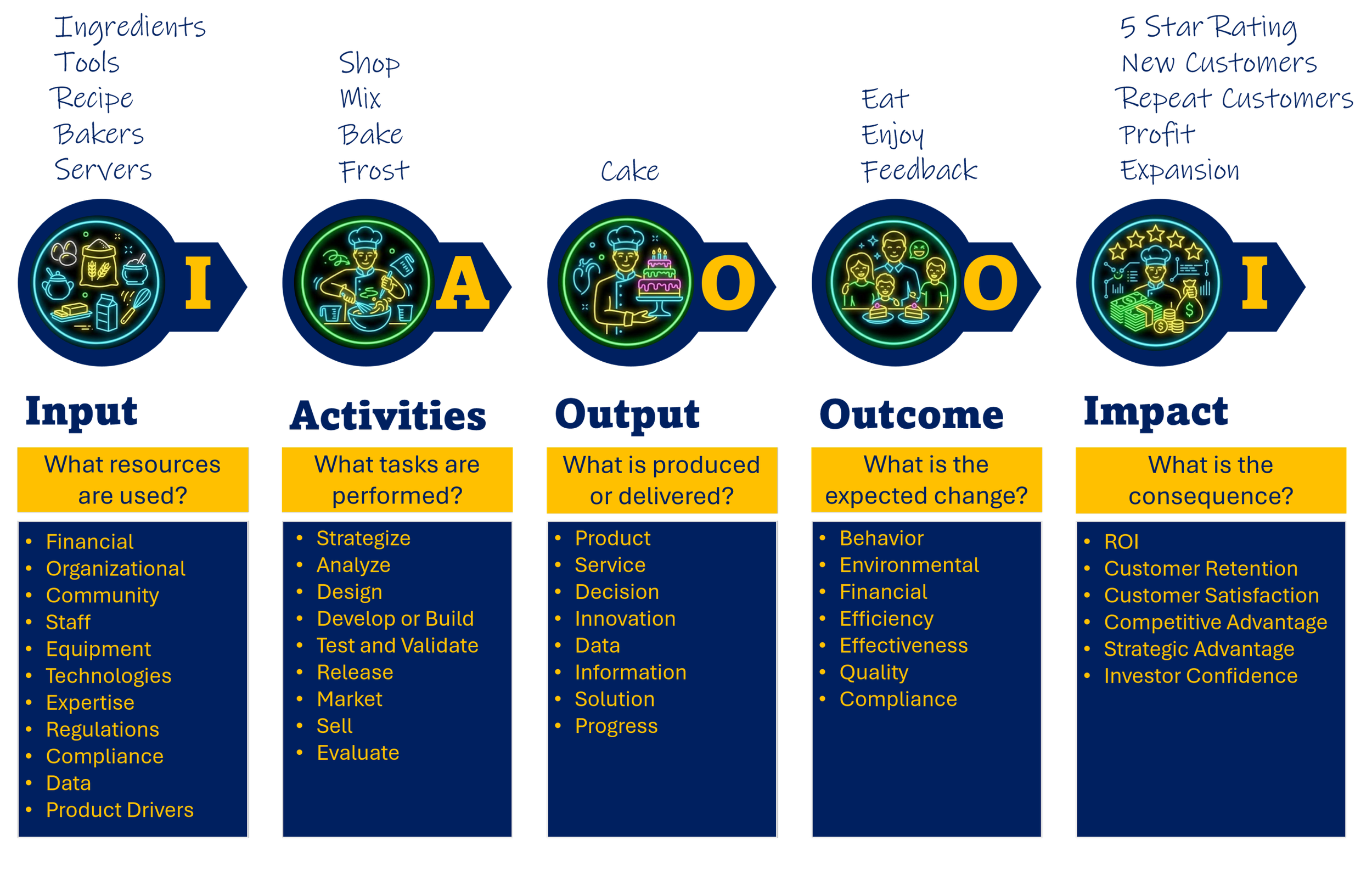
Figure 2: Results Chain
SMART Metrics
Effective project management requires setting clear goals and monitoring progress consistently. By establishing metrics from the onset, organizations can track progress, identify potential issues early on, and make informed decisions to ensure the project aligns with its objectives. Furthermore, the practice of tracking metrics is essential for ensuring transparency, accountability, and alignment throughout the duration of a project.
SMART metrics—those that are Specific, Measurable, Achievable, Relevant, and Timebound—make up a fundamental framework for developing goals that are both actionable and measurable.
SMART goals are designed to address all key functions, processes, and deliverables. The purpose of SMART goals is to direct attention and resources toward what is most important in order to successfully achieve project objectives and priorities. SMART metrics help ensure that objectives are both ambitious and practical, allowing teams to track progress effectively while staying aligned with broader strategic goals. The method ensures that the metrics are:
Specific: The goal must be clearly defined and unambiguous, outlining what is being pursued, why it matters, who is responsible, where it will be tracked, when to measure progress, how it will be evaluated, and which tools will be used.
Measurable: Progress toward goals must be assessed using clear, quantifiable data or indicators. This approach transforms subjective ambitions into concrete objectives, enabling fair and impartial evaluations of success.
Achievable: Goals should be challenging yet achievable, striking a balance between ambition and realism. Establishing realistic targets within current resources and constraints helps maintain focus and prevent discouragement. The goals are meant to inspire motivation rather than overwhelm them.
Relevant: Emphasize focus on actions that align with broader strategic goals. This ensures every effort contributes meaningfully to strategic objectives.
Timebound: Goals should have a clear deadline or time frame for completion, ensuring that progress and achievements are measured within this designated period.
The Balanced Scorecard (BSC), Key Performance Indicators (KPIs), and Objectives and Key Results (OKRs) are distinct frameworks, each tailored to specific aspects of goal setting, performance management, and strategic planning. While they share common goals, such as creating alignment, measuring progress, and enhancing performance, they differ significantly in their application and focus. In short, BSC is a framework used to outline and manage strategic initiatives, KPIs are long-term metrics for monitoring performance, and OKRs help set short-term goals at an individual level.
By understanding the differences between these three frameworks, organizations can leverage the strengths of each to align their strategies, monitor progress, and achieve both long-term and short-term objectives effectively.
For deeper insight into SMART metrics, explore the SMART metrics article at https://ganttpost.com/ganttposts/smart-metrics —and discover more practical, research‑driven insight across the Gantt Post library of articles and guides.
Applying RBM
Unlocking the full potential of RBM requires seamless integration of the Results Chain and Theory of Change frameworks, alongside disciplined application of SMART metrics. RBM should serve as the foundation, not only during planning but as a continuous guiding principle throughout every stage of a project or product lifecycle.
To maximize RBM effectiveness, harness the Results Chain to pinpoint desired outcomes and impacts, and map the essential outputs, inputs, and activities needed to achieve targets. Apply the Theory of Change to analyze underlying assumptions, consider external influences, and proactively identify potential risks. By consistently using SMART metrics, projects can monitor, assess, and improve performance, ensuring targets are met. This integrated and intentional approach guarantees successful RBM implementation and maximizes benefits for projects and stakeholders.
RBM is an empirical, iterative process with four phases: Planning, Implementation, Monitoring and Evaluation, and Learning and Adaptation.
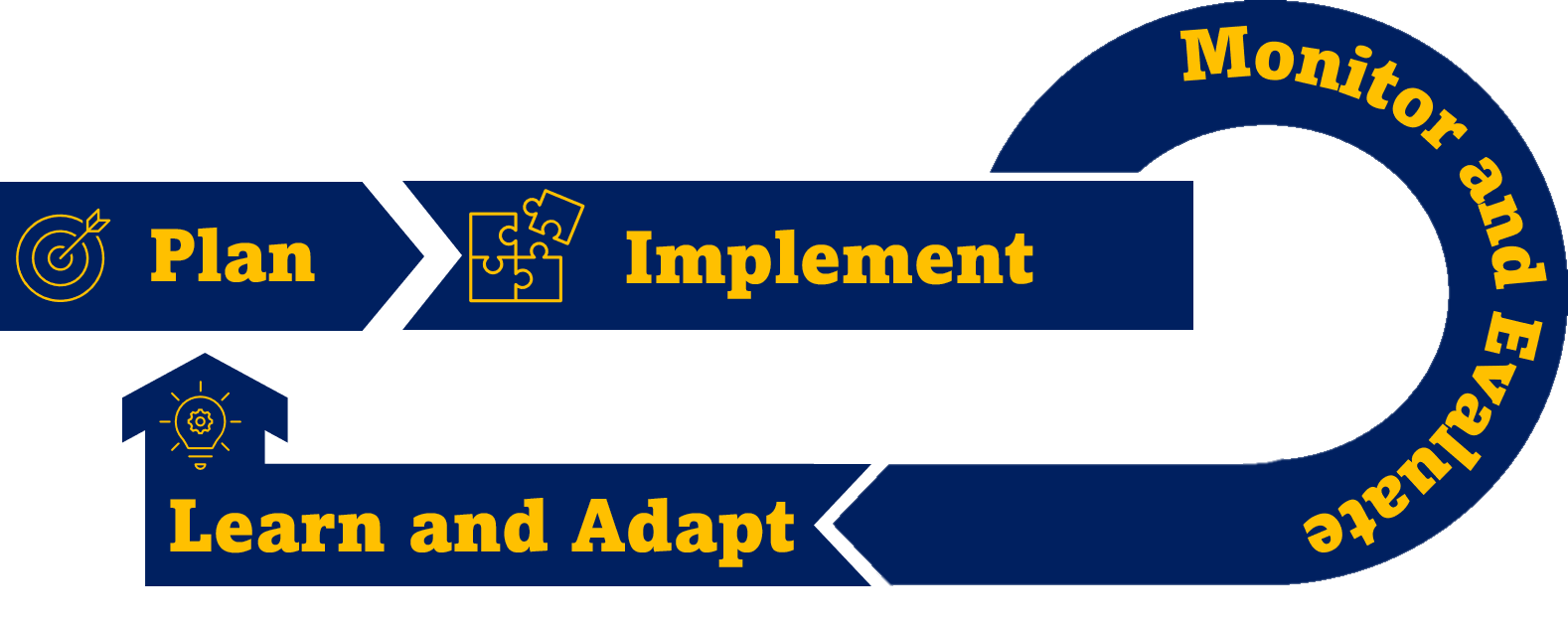
Figure 3: Applying RBM to Project Management
Phase 1: Planning
In RBM, the primary goal during the planning phase is to concentrate on achieving desired results and establishing a solid foundation for success. It is crucial to map the relationships among the Results Chain components, ensuring each element logically leads to the previous element. Identify the specific outputs needed to drive outcomes and determine the activities and inputs required to produce those results. By maintaining clear connections and focusing on purposeful actions, this approach promotes efficiency, accountability, and strong alignment with organizational objectives.
Step 1: Begin with the Results Chain and conduct a backward mapping exercise. In RBM, backward mapping is a strategic planning method that starts by clearly defining the intended final impact or outcome. From there, work backward to pinpoint the essential outputs, activities, and inputs required to achieve those results.
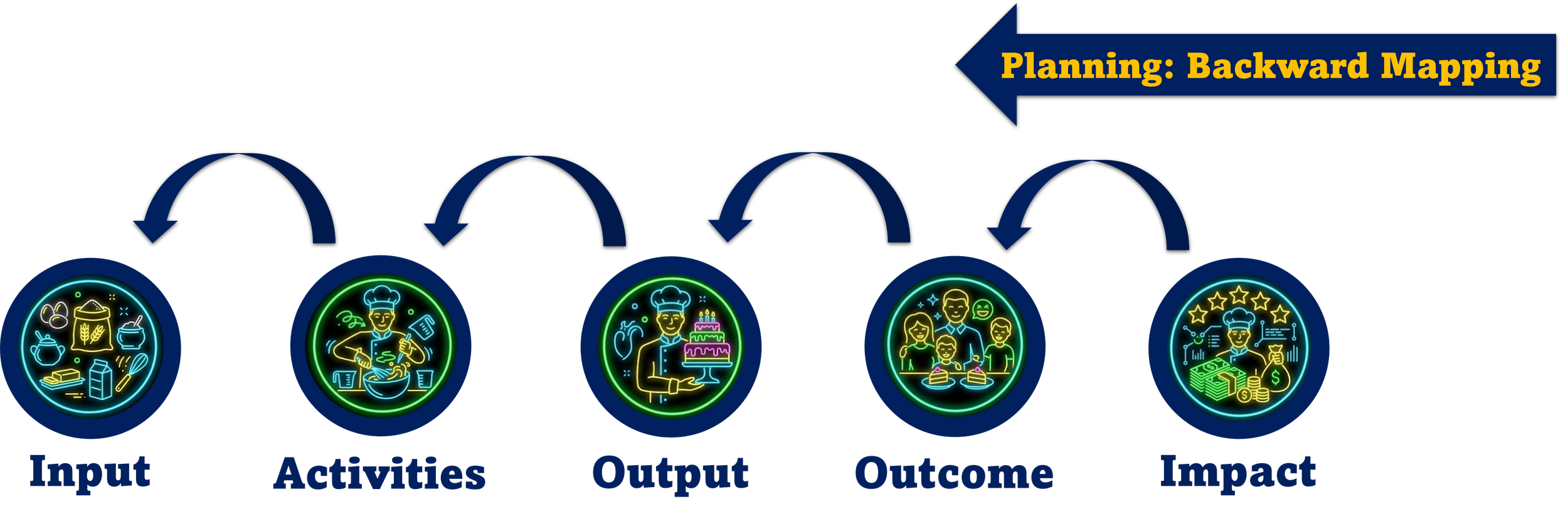
Figure 4: Backward Mapping
Step 2: Apply the Theory of Change to assess and validate the underlying assumptions within the Results Chain. Evaluate how external influences—such as social, economic, or environmental factors—might affect the achievement of intended outcomes. Proactively identify and involve relevant stakeholders to gather their input, feedback, and expertise, ensuring their perspectives are integrated into the planning process. Based on these findings, refine and adjust the attributes of the Results Chain components as necessary to strengthen the logic and feasibility of the approach.
Step 3: Identify and establish measurement indicators. Based on organizational needs and operational maturity, select an appropriate mix of BCS, KPIs, and OKRs to articulate goals and define success criteria. Ensure all metrics are SMART and closely aligned with the overall objectives. Communicate these metrics clearly to stakeholders and the team to foster shared understanding and accountability.
Step 4: Clearly delineate and define the roles and responsibilities of the delivery team, stakeholders, and all supporting partners. Facilitate open and thorough communication to ensure every participant understands and agrees with their specific duties and expectations. Confirm alignment and mutual concurrence among all parties to foster effective collaboration throughout the project.
Step 5: Develop a comprehensive communication strategy that specifies the methods and frequency for sharing progress updates and essential information with all stakeholders and the delivery team. Ensure the strategy promotes transparency, timely feedback, and keeps everyone informed throughout the implementation phase.
Step 6: Finalize the plan and move into the implementation phase. Ensure the plan is clearly communicated and distributed to all stakeholders and the delivery team. Provide opportunities for feedback and clarification so everyone is aligned and prepared to execute their roles effectively.
Phase 2: Implementation
The implementation phase of RBM involves putting the established plan into action. The primary objective during this phase is to deliver outputs that directly contribute to achieving the desired outcome and ultimate impact. Key to this process is mapping the relationships within the Results Chain, ensuring each component logically connects to the next. By maintaining these clear linkages and focusing on intentional actions, the approach ensures that sufficient resources, well-defined processes, and effective techniques are in place—providing everything necessary to achieve the intended outputs.
Step 1: Begin with the Results Chain and use forward mapping to connect inputs to activities, outputs, and eventual outcomes and impacts. Forward mapping refers to moving along the Results Chain from left to right: Beginning with inputs and activities, then generating outputs, which eventually lead to outcomes and impacts. This approach establishes clear, causal relationships by demonstrating how each intended action and allocated resource leads to the desired result. It often employs “if-then” reasoning to ensure that planning directly supports the targeted impacts.
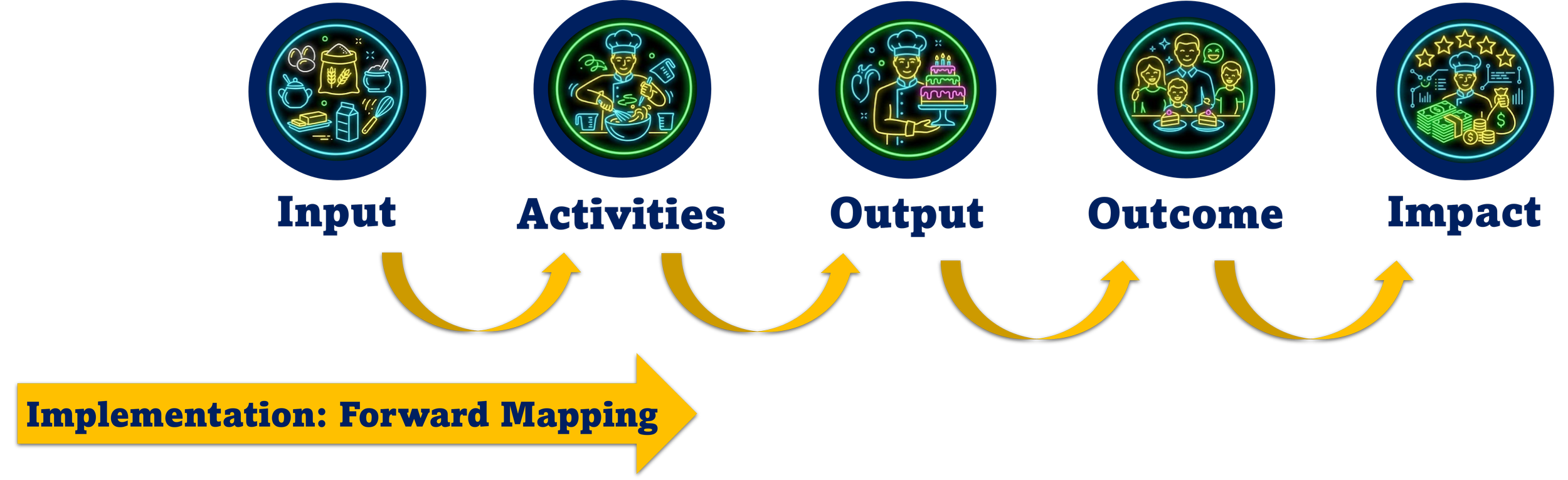
Figure 5: Forward Mapping
Step 2: Ensure all essential resources are available by sourcing the necessary expertise, gathering relevant information, and providing the team with appropriate tools and systems to successfully carry out the planned activities.
Step 3: Design and implement robust processes, efficient workflows, and effective techniques that enable the team to complete activities effectively and efficiently.
Step 4: Deliver targeted training, coaching, and mentoring to ensure team members possess the necessary knowledge and skills to confidently and competently execute their assigned tasks.
Phase 3: Monitoring and Evaluation
Once implementation is underway, it is important to maintain ongoing monitoring and evaluation within the RBM framework. Monitoring consists of collecting and analyzing data for each part of the Results Chain, allowing organizations to detect gaps and risks that may hinder progress. Evaluation, meanwhile, focuses on measuring how effective, efficient, relevant, and sustainable the adopted mitigation strategies are. By regularly practicing both monitoring and evaluation, organizations can spot emerging issues early, make well-informed decisions to manage risks, and continually improve their overall performance.
Step 1: Collect and analyze data using metrics and performance indicators. Examine the data to identify trends, patterns, and risks that may negatively impact the results. Examples of key indicators for monitoring within an RBM framework include:
Performance indicators, such as activity completion rates and cycle times.
Utilization metrics, including resource allocation, resource consumption, and infrastructure usage.
Quality measures, like first pass yield rates, defect counts, and cost of quality.
Throughput analysis, such as output yield and on-time delivery.
Outcome evaluation through customer satisfaction scores and feedback.
Impact analysis, including sales growth, profit yield, and customer retention rates.
Step 2: Through structured and established forums and platforms, collect and analyze feedback and input. Evaluate the effectiveness of previously implemented corrective and preventive actions. Common evaluation methods include:
Conducting retrospectives to collect insights and feedback from team members.
Holding progress reviews with relevant stakeholders to assess ongoing outcomes.
Gathering customer experience feedback to evaluate satisfaction and effectiveness.
Collecting user experience feedback to analyze usability and engagement.
Soliciting community feedback to understand broader impact and perceptions.
Step 3: Regularly review the initial assumptions and external factors, evaluating their ongoing relevance and applicability for the current context.
Phase 4: Learning and Adaptation
RBM stands out as a modern management approach, placing a strong emphasis on flexibility and adaptability in response to evolving conditions and situations. By leveraging data gathered and assessed during the monitoring and evaluation phase, the Learning and Adaptation phase acts as a proactive process to identify and resolve gaps and effectively mitigate risks. This continuous, feedback-driven process ensures that RBM remains an agile and resilient framework, driving ongoing improvement and organizational success.
Learning involves using the Theory of Change and Results Chain to test and confirm assumptions, assess the impact of external factors on planned activities, and pinpoint the underlying causes of gaps and risks. By adopting an empirical approach, further testing and experimentation can be carried out to validate hypotheses and strengthen the reliability of assumptions.
The primary objective of adaptation is to draft preventive and corrective actions to close identified gaps and mitigate risks. This process also includes reworking the backward mapping to redesign actions and confirm that anticipated results remain achievable. As an agile and iterative framework, RBM strategically adjusts its plans based on insights obtained from preceding phases.
Principles of RBM
Like many frameworks, RBM is founded on guiding principles. These principles are not rigid rules; rather, they serve to shift the management approach from simply tracking activities to focusing on outcomes for greater impact. RBM highlights the importance of clear objectives, active stakeholder involvement, evidence-based decision-making, and flexible delivery. By following these principles, initiatives are more likely to achieve meaningful results through effective planning, monitoring, and adaptation.
Focus on Results: In the Results Chain framework, the RBM planning phase starts with a clear definition of the desired outcomes and impacts. This clarity then shapes the identification of essential outputs, activities, and inputs needed to reach those goals. By mapping backward from results, organizations stay focused on their objectives and can develop specific attainable metrics to assess performance. This approach also enables timely, data-driven adjustments to ensure continued progress toward the intended results.
Clarity in Objectives: The backward mapping approach in the RBM planning phase begins by clearly identifying the desired goals and objectives for the expected results. These goals and objectives form the foundation for establishing SMART metrics, which are essential for effectively measuring and analyzing performance. By defining clear metrics, both stakeholders and the delivery team gain a shared understanding of the objectives, promoting transparency and fostering trust throughout the process.
Monitoring and Evaluation: Establishing clear, measurable performance indicators from the outset enables accurate tracking of progress and facilitates strategic adjustments as needed. Ongoing monitoring involves collecting and analyzing data related to each component of the Results Chain to pinpoint gaps and risks that could negatively affect outcomes. In contrast, evaluation is a process that assesses the effectiveness, efficiency, relevance, and sustainability of the mitigation measures implemented. By consistently applying both monitoring and evaluation, organizations can proactively identify challenges, make informed decisions to mitigate risks, and continuously enhance performance over time.
Stakeholder Engagement: Active and meaningful participation of all internal and external stakeholders is a fundamental aspect of RBM, ensuring diverse perspectives, needs, expertise, and interests from the community are included. This inclusive approach to stakeholder engagement encourages ownership, strengthens community involvement, fosters mutual understanding and agreement on goals and objectives, builds trust and confidence within the community, and drives positive momentum toward achieving success.
Flexibility and Adaptability: Projects frequently encounter unforeseen challenges and evolving circumstances, making flexibility and adaptability in both strategy and tactics essential. The flexible and adaptive approach of RBM allows adjusting strategies, approaches, and activities in real time as new information emerges or situations change. RBM is rooted in an empirical, iterative, and agile model of planning and execution. By routinely evaluating the Results Chain, testing underlying assumptions, and actively incorporating feedback, RBM ensures proactive adjustments are made to address risks and bridge identified gaps, fostering resilience and promoting successful outcomes.
Accountability and Transparency: Continuous monitoring and proactive reporting of performance fosters transparency and ensures that everyone is held accountable for their actions, decisions, and outcomes. Accountability requires clearly defined responsibilities and expectations, and effective methods for tracking and reporting progress. Transparency involves openly sharing relevant information with stakeholders and the delivery team. Together, these practices build trust, credibility, and confidence, encouraging greater stakeholder support and collaboration.
Common Mistakes to Avoid
As with any management approach, organizations often encounter common mistakes that can threaten the effectiveness of RBM. Recognizing and proactively avoiding these pitfalls is essential for ensuring RBM is implemented successfully and delivers meaningful outcomes.
Unclear Definitions of the Results Chain: One of the most frequent pitfalls in RBM is failing to clearly define and understand the Results Chain. When impacts, outcomes, outputs, activities, and inputs are not distinctly defined and articulated, organizations struggle to understand how the results contribute to strategic goals. This confusion can lead to misaligned priorities and missed opportunities for impact. A clear and shared understanding of the Results Chain's definitions helps everyone stay focused and allows for meaningful tracking of progress.
Abandoning the RBM Post-Planning Phase: RBM is frequently viewed as a crucial framework during the planning phase, but its real value lies in its consistent application throughout the entire project or product lifecycle. As conditions and variables evolve, ongoing integration of RBM allows teams to learn from emerging challenges, adapt strategies, and improve performance. By maintaining RBM at the heart of implementation, monitoring, and reporting, projects stay agile, responsive, and focused on achieving meaningful results.
Ignoring Data and Feedback for Decision-Making: Decisions made by consistent collection and analysis of data and stakeholder feedback are essential for successful RBM. Ignoring these inputs can result in employing obsolete techniques, following unnecessary irrelevant approaches, and wasting valuable resources. Consistently collecting, analyzing, and acting on quality data empowers teams to make informed decisions, timely adjustments, and enhance project outcomes.
Rigid Structure for Project Management: While structure is important, excessive rigidity can hinder innovation and responsiveness. Projects managed with inflexible frameworks often fail to adapt to evolving conditions and variables, limiting their potential for impact or completely missing the target. RBM allows for iterative learning and adjustment, serving as a flexible, adaptable platform to address challenges and new opportunities as they arise.
Not Engaging Stakeholders: Overlooking stakeholder engagement can undermine the relevance and sustainability of project results. Stakeholders bring invaluable perspectives and can help identify risks, refine strategies, and foster buy-in. Proactive, inclusive engagement ensures that the project addresses genuine needs and is more likely to achieve lasting success.
Inconsistent Monitoring and Evaluation: Monitoring and evaluation should be consistent and ongoing, not sporadic or reactive. Inconsistent practices make it difficult to measure progress, learn from experience, or demonstrate accountability. Establishing regular, robust monitoring and evaluation routines builds credibility in the team, confidence in the results, and enables continuous improvement.
Metrics are not SMART: Using metrics that are not SMART undermines the ability to track progress or prove outcome and impact. Vague or unrealistic indicators leave teams guessing whether goals are being met—risking losing trust and confidence in the project. Applying the SMART framework ensures clarity, accountability, and a stronger foundation for achieving meaningful, attainable results, fostering inspiration and morale in the team.
Conclusion
In conclusion, integrating RBM from the very beginning of an endeavor provides a structured yet flexible and adaptable framework that focuses on achieving meaningful outcomes and lasting impact. By starting with clear outcomes and impacts in the Results Chain, and then identifying the essential outputs, inputs, and activities, the team gains both the necessary tools and a unified vision for the product. Employing a Theory of Change to examine underlying assumptions and key influencing factors enables proactive risk identification and gap analysis, ensuring these challenges are addressed effectively. Through a commitment to clear objectives, ongoing progress monitoring, and strategy adjustments informed by data-driven insights, RBM strengthens accountability and increases overall effectiveness. Ultimately, this approach empowers project teams to deliver sustainable results and maximize stakeholder value.
