
Preface
This article builds on “Beyond Instinct: A Practical Guide to Better Decision-Making,” published at www.ganttpost.com. Readers are encouraged to begin with that article, which establishes the essential principles of sound decision-making and provides the foundation for the ideas developed here. With those fundamentals in place, this complementary piece examines the cognitive biases that can shape outcomes, the decision-making styles leaders can apply, and practical strategies for navigating common situations that demand thoughtful judgment.
Introduction
Two weeks before launch, the market research delivers a clear warning: Stop. But after six months of work, the team refuses to turn back. You override the evidence and give the order: Launch.
Six weeks later, the product fails. Customers reject it, sales stall, and the decision meant to protect six months of work puts the future of the company at risk.
How did a smart team turn a clear warning into approval to proceed?
The answer is cognitive bias: The hidden co-pilot in every decision. Your decision-making authority puts you in the driver’s seat, but bias can quietly seize the wheel—turning a trusted strength into a liability and steering you toward unintended outcomes.
When your personal decision style collides with hidden biases, it creates a perfect storm for project failure. A decisive, action-oriented leader fueled by “Confirmation Bias” will speed the team right off a cliff, while a highly collaborative group gripped by the “Sunk Cost Fallacy” will agree to steer the ship directly into an iceberg.
Before your next planning meeting gets derailed by this harmful combination, let’s pull back the curtain on the hidden psychology of how your decision style and biases interact—and how you can finally outsmart your own instincts.
Cognitive Bias
A cognitive bias is a systematic pattern of thinking that can distort judgment and influence decisions. One common cause is our reliance on mental shortcuts—known as heuristics—to reach conclusions quickly with limited time, information, or attention.
Decision-making may follow an algorithm or rely on a heuristic. An algorithm uses a defined, step-by-step process to seek the correct answer; because it evaluates the problem systematically, it is usually more rigorous but also more time-consuming. A heuristic takes a different approach: It trades absolute accuracy and certainty for speed and practicality, using experience or a rule of thumb to reach a workable judgment without examining every possibility.
Relying on heuristics is often useful and does not inherently lead to poor outcomes. Navigating daily activities presents countless decisions that neither require nor justify exhaustive analysis. By simplifying these judgments, heuristics spare the mind from unnecessary cognitive strain and preserve limited attention and mental capacity for decisions that demand deeper analysis.
However, these shortcuts can become costly when they cause important information to be overlooked or reinforce irrelevant assumptions and preexisting biases. In certain circumstances, relying on heuristics can introduce systematic errors or distortions in judgment and understanding—patterns commonly known as cognitive biases.
Heuristics and cognitive biases are, therefore, closely related, but they are not the same. A heuristic is a decision-making strategy; a cognitive bias is a distortion in judgment. Heuristics do not automatically produce bias, but they can make bias more likely when they are overused, applied in the wrong context, or left untested against evidence.
Although heuristics are a common source of cognitive bias, they are only part of the picture. Cognitive bias can also emerge from emotion, memory, social influence, personal experience, and the way information is framed or presented. Some examples include:
Limited Capacity to Process Information: While it varies by person, the mind has limited capacity to review, analyze, store, and recall information, making it impossible to consider every relevant detail when drawing an inference or making a decision. Attention must, therefore, focus on a subset of the available information, which can cause important evidence to be overlooked or underweighted.
Information Overload: When a flood of competing information arrives at once, the mind must filter rapidly and prioritize what appears most noticeable or immediately relevant. Although necessary, this filtering can distort judgment by overshadowing subtler but more consequential evidence.
Emotional Connections: Fear, attachment, anger, excitement, and other emotional states can alter the interpretation of evidence and the assessment of risk. A decision involving a close acquaintance, for example, may be judged differently from the same decision involving a stranger.
Underlying Motivations: Existing beliefs, goals, and incentives can influence which evidence is sought, accepted, or dismissed. Information and strategies that support the desired outcome may be unconsciously favored over the conclusion that is best supported by the facts.
Social Pressure and Cultural Influence: The desire for acceptance or approval can encourage conformity with opinions expressed by others, even when independent judgment points elsewhere. Group norms, personal connections, and cultural context can, therefore, influence both individual choices and collective outcomes.
Natural Instinct: Automatic judgments and responses often take control before deliberate reasoning has a chance to intervene. These intuitive reactions can be valuable in familiar situations, but they become less reliable when circumstances are new, ambiguous, or demand careful comparison of evidence.
Age-Based Inflexibility: Evidence suggests that some aspects of cognitive flexibility may decline with age, making familiar assumptions and established patterns harder to reconsider. This can increase susceptibility to certain cognitive biases; on the contrary, the effect varies widely, and accumulated knowledge and experience can also strengthen judgment.
Researchers have identified hundreds of cognitive biases. The following examples highlight several of the most common biases and show how quietly they can shape everyday judgment and decision-making:
Confirmation Bias: The tendency to seek, interpret, and remember information that supports existing beliefs while dismissing, minimizing, or overlooking contradictory evidence. As a result, decision-makers may reinforce existing assumptions rather than evaluate reality with objectivity.
Anchoring Bias: The tendency to rely too heavily on the first piece of information encountered when making a judgment. Whether it is a number, an opinion, or an assumption, that starting point can shape everything that follows—even when better information comes along.
Authority Bias: The tendency to place too much trust in and align with the opinions or advice of people seen as authority figures. This can cause teams to dismiss or discount better ideas simply because those ideas come from someone with less seniority or influence.
Ambiguity Bias: The tendency to choose options with clear odds over those where the outcome is less certain. Playing it safe can feel more comfortable, but it may also mean passing up new ideas, useful experiments, or better opportunities.
Availability Bias: The tendency to think something is more likely or important simply because an example comes to mind easily—often because it is recent, vivid, or emotional. This can make what is easiest to remember feel more common or probable than the broader facts actually show.
Dunning–Kruger Effect: When people misjudge their own ability. Those with limited skills or knowledge may feel more confident than their performance supports, while highly capable people may underestimate themselves. Either way, an inaccurate view of competence can lead to poor judgment and bad decisions.
Attentional Bias: When the brain receives far more information than it can consciously process, attention quickly locks onto cues tied to immediate concerns—such as a threat, worry, or issue. Once that happens, the narrow focus can shape decisions by pushing other important facts, risks, and opportunities out of view.
Sunk Cost Bias: The tendency to continue a course of action because of resources already invested, even when future costs outweigh expected benefits. Sound decisions should focus on prospective value and expected outcomes, not sunk costs.
Status Quo Bias: The tendency to prefer existing conditions simply because they are familiar or already in place. Inaction can then become the default even when evidence supports a better alternative.
Conformity Bias: The tendency to align opinions, decisions, or behavior with those of a group, even when independent judgment suggests otherwise. By placing consensus above critical evaluation, this bias can foster groupthink and suppress meaningful consideration of alternative perspectives.
Least-Effort Tendency: The tendency to choose the simplest or easiest solution rather than the one most likely to be effective. Although efficiency can be valuable, this bias may lead to oversimplified decisions that fail to address the underlying issues.
Hyperbolic Discounting: The tendency to favor a smaller immediate reward over a larger delayed reward, with preferences often shifting as the immediate option draws nearer. It can sacrifice long-term value for short-term gratification.
Framing Effect: The tendency for decisions to be influenced by how information is presented rather than by the information itself. The same facts can lead to different choices depending on whether they are framed as gains or as losses.
Self-Serving Bias: The tendency to attribute success more readily to personal ability or effort and failure more readily to external circumstances. It can weaken accountability, obstruct learning, and erode trust and confidence.
Halo or Horn Effect: When one noticeable trait or first impression shapes how we judge everything else about a person, product, team, or idea. The halo effect happens when something positive—such as charm, appearance, or a well-known brand name—leads us to assume other good qualities, like intelligence, honesty, competence, or overall quality. The horn effect works in the opposite way: One negative trait can unfairly affect the entire judgment. In both cases, a single impression gets in the way of a fair evaluation of the evidence.
Outcome Bias: The tendency to evaluate a decision by its outcome rather than by the quality of the reasoning and information available when it was made. Because luck, timing, and chance can shape decision-making, a sound decision may produce a poor outcome, while a reckless decision may succeed. By ignoring the distinction between skill and luck, outcome bias distorts how past decisions are judged. This can lead to flawed choices in similar situations.
Similarity Bias: The tendency to respond more favorably to people, ideas, or approaches perceived as similar to their own. It can narrow participation, reduce diversity of thought, and limit creativity.
Loss Aversion: The tendency to feel the impact of a loss more strongly than the benefit of equal gain. This can make leaders overly cautious, resistant to change, and more likely to miss worthwhile opportunities.
Cultural Bias: The tendency to judge people, ideas, or situations through the lens of familiar cultural norms and assumptions. When left unexamined, such assumptions can lead to misread differences, overlooked perspectives, and unfair or ineffective decisions.
Gambler’s Fallacy: Also known as the Monte Carlo fallacy, this is the mistaken belief that past random events change the odds of what happens next—as if a streak must soon reverse to balance the scales. In reality, when events are independent, each one starts fresh with the same fixed probability, no matter what came before.
Stereotyping Bias: The tendency to assume someone has certain traits, skills, or behaviors simply because they belong to a particular social group, without considering the facts about that individual. These assumptions can be implicit (automatic and subconscious) or explicit (conscious and deliberate). Either way, stereotyping can fuel prejudice and discrimination, distort decisions, and shut out valuable perspectives.
Political or Ideological Bias: When political views or strongly held beliefs shape how evidence is understood. This can make opposing facts easier to question, supporting claims easier to accept, and personal beliefs harder to challenge.
Belief Bias: The tendency to judge an argument by whether its conclusion seems believable rather than questioning whether the reasoning is logically valid. A plausible conclusion can, therefore, conceal a weak argument.
Recency Bias: The tendency to give too much weight to the latest information while overlooking older evidence and longer-term patterns. Because recent events are easier to remember, they can seem more important or typical than they really are.
Negativity Bias: The tendency for negative information and experiences to command more attention and influence than comparable positive ones. By making threats and setbacks loom larger than they are, this bias can fuel undue pessimism and distort sound judgments about risk.
Cognitive biases cannot be eliminated. The brain is naturally wired to rely on mental shortcuts. But when the outcome and impact demand it, it is important to step back, widen the view, and use safeguards that keep unconscious bias from steering judgment in the wrong direction. Research suggests that bias can be managed more effectively by recognizing situations, questioning assumptions, seeking input from people with different perspectives, separating relevant evidence from outside influences, and using consistent, fact-based decision processes.
Decision-Making Styles
Effective decision-making involves more than reaching a conclusion or choosing an option. The process requires navigating complexity, building trust, and inspiring confidence while protecting the product and the mission from unnecessary risk. Success also depends on clear rationale, effective communication, and confident leadership during implementation.
No single decision-making approach fits every situation. As documented in Managerial Decision Making: A Guide to Successful Business Decisions (1992) by Alan J. Rowe and James D. Boulgarides, there are four decision styles shaped by two dimensions: Cognitive Complexity and Value Orientation.
Cognitive Complexity—Structure Versus Ambiguity: This dimension reflects a preference for either clearly defined processes and expectations (structure) or greater flexibility when dealing with uncertainty and open-ended situations (ambiguity).
Value Orientation—Task/Technical Versus People/Social: This dimension reflects whether a decision is driven primarily by accuracy and results (task) or by relationships, collaboration, and social impact (social).
Decision Style Theory explains that the interaction between these two dimensions produces four distinct decision-making styles. Understanding each style can support better judgment, clearer communication, and a more deliberate response to the demands of a specific situation.
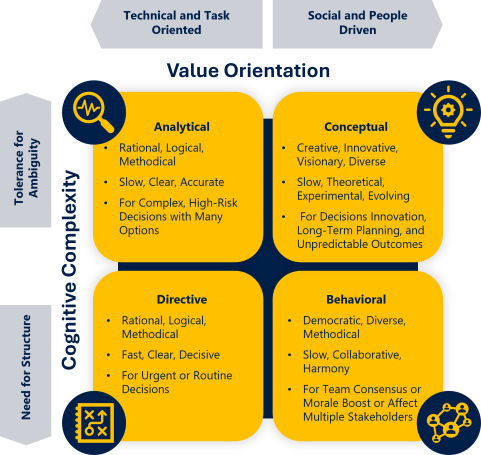
Directive Style:
The directive decision-making style emphasizes speed, structure, and clear action. Decisions are generally made independently, with little or no consultation to gather additional information, perspectives, or insight. Instead, directive decision-makers rely primarily on established facts, rules, procedures, and their own relevant experience, seeking only the information needed to reach a practical conclusion. This approach works especially well in fast-moving environments, routine situations, and decisions with predictable outcomes.
Dimensions: Low tolerance for ambiguity, a strong preference for structure, and a task- or technical-oriented focus with limited focus on people or social aspects.
Characteristics: Makes decisions quickly, favors concise and relevant information, and draws heavily on personal experience. Uses established guidelines and procedures to streamline choices, values action over extended analysis, and remains strongly focused on results.
Advantages: Effective for routine, short-term, urgent, or crisis decisions. The approach is logical, efficient, and easy to implement; it also reduces decision fatigue and makes accountability clear.
Limitations: Speed and independence can narrow the range of information and perspectives considered. Overreliance on personal experience may oversimplify complex problems, reduce collaboration, and limit creativity or innovation.
Best Fit Scenarios: Most useful when time is critical, the situation is stable or familiar, and the relationship between cause and effect is clear. It is well suited to emergencies, high-pressure settings, routine operations, and decisions governed by established rules.
Analytical Style:
The analytical decision-making style emphasizes thorough evaluation of data-driven insight and evidence and logical reasoning before action. Analytical decision-makers are comfortable with complexity and ambiguity when they have enough time and information to examine the issue. They gather and organize substantial data, compare multiple alternatives, and seek the strongest solution. They may consult others for relevant expertise and information, but, typically, retain close control over the analysis and final decision.
Dimensions: High tolerance for ambiguity, comfortable with limited structure, and a strong task- or technical-oriented focus, with less emphasis on people or social considerations.
Characteristics: Gathers and organizes extensive information, examines details carefully, compares alternatives, and relies on evidence and logic to reach a conclusion. The approach is patient, methodical, and adaptable as new information emerges. Input from others is valued when it adds useful data or expertise, but the decision remains strongly focused on achieving the best technical- or task-related result.
Advantages: Produces comprehensive, well-supported, and defensible decisions by testing assumptions, comparing alternatives, and examining details others may miss. This style can improve accuracy, anticipate consequences, reduce risk, and uncover innovative or creative solutions.
Limitations: Depends on the availability and quality of relevant information. Extensive analysis can become time-consuming, create decision fatigue, and can lead to analysis paralysis. Opportunities may be lost when the search for a better answer delays action beyond the effective window.
Best Fit Scenarios: Most useful for complex, unfamiliar, technical, or high-risk decisions that require careful analysis and accuracy. It is especially effective when several viable answers exist and the cause-and-effect relationship can be discovered through evidence, even if it is not immediately clear. This style works best when enough reliable information and time are available to evaluate alternatives thoroughly.
Conceptual Style:
The conceptual decision-making style emphasizes creativity, collaboration, and long-term visionary thinking. Conceptual decision-makers are comfortable with ambiguity and explore a broad range of possibilities before committing to a course of action. They actively seek diverse perspectives, combine evidence with intuition, and look for emerging patterns that connect a decision to wider goals and future impact. This approach encourages unconventional ideas, thoughtful risk-taking, and solutions that address both organizational priorities and the people affected.
Dimensions: High tolerance for ambiguity, comfortable with limited structure, and a strong people- or social-oriented focus.
Characteristics: Thinks broadly, creatively, and strategically, with a focus on long-term possibilities and multiple alternatives. Seeks input from people with different perspectives, integrates varied information, and uses intuition to identify patterns and connections. Encourages experimentation, open communication, and reflection while pursuing holistic solutions that can create meaningful impact.
Advantages: Strong at generating ideas, challenging assumptions, and navigating novel or unpredictable situations. The approach supports creative problem-solving, calculated risk-taking, and adaptation as conditions change. Its broad perspective can reveal unique solutions while accounting for long-term strategy and relevant human, ethical, cultural, environmental, and regulatory considerations.
Limitations: A steady flow of new ideas can make it difficult to narrow the options and reach a final decision. The process can be time-consuming, and broad or visionary concepts may be difficult to translate into practical steps. Without clear priorities, deadlines, and ownership, exploration can continue longer than the situation allows.
Best Fit Scenarios: Most useful for strategic, innovative, unfamiliar, or rapidly changing decisions where the path forward is not immediately clear. It is well suited to long-term planning, product or service development, organizational change, and other situations that benefit from diverse perspectives and creative alternatives. This style is especially effective when solutions must emerge through exploration, experimentation, and learning over time.
Behavioral Style:
The behavioral decision-making style emphasizes collaboration, relationships, and acceptance. Behavioral decision-makers prefer structure and clear expectations, but they gather information and insight through conversation, interaction, and feedback from others. They typically consider a manageable number of options, work to build agreement, and favor solutions that support team harmony, commitment, and the well-being of the people affected.
This style is highly collaborative and depends on open, effective communication. Rather than deciding in isolation, the decision-maker invites stakeholders to discuss the available options, weigh their practical and social effects, and identify a path the group can support. The goal is not simply to keep everyone happy, but to strengthen trust, reduce resistance, and build the commitment needed for successful implementation.
Dimensions: Low tolerance for ambiguity, a strong preference for structure, and a people- or social-oriented focus.
Characteristics: Consults stakeholders, listens closely to explicit feedback and interpersonal cues, and considers how a decision will affect relationships, morale, group cohesion, and harmony. The approach is empathetic, supportive, and consensus-oriented, with an emphasis on communication, participation, and solutions that most stakeholders can accept and implement.
Advantages: Builds trust, inclusion, and organizational buy-in through a democratic process that gives affected stakeholders a meaningful voice. Diverse perspectives can improve understanding of people-related concerns, while shared involvement can strengthen morale, confidence, commitment, and support during implementation.
Limitations: Consultation and consensus-building can slow decisions, especially when many stakeholders are involved or views conflict. A strong desire for harmony may discourage necessary debate, soften difficult choices, or favor acceptance over evidence and results. The style may also be less effective when speed, confidentiality, or decisive action is critical.
Best Fit Scenarios: Most useful when a decision directly affects employees or multiple stakeholders and successful implementation depends on their understanding, trust, and active support. It is well suited to team policies, workplace changes, conflict resolution, and other situations where morale, relationships, and sustained commitment matter as much as the immediate outcome.
Besides the Decision Style Theory proposed by Rowe and Boulgarides, leaders may demonstrate other secondary decision-making styles that can influence both the process and the outcome of a decision. These approaches may reflect personal tendencies—how someone naturally defaults to making decisions—or may be adapted to suit a particular situation. In either case, the leader should carefully assess the circumstances and apply the approach that best fits the urgency, complexity, risk, and impact. When the situation is not carefully evaluated, or the approach is poorly matched, the decision can undermine judgment and produce unintended or undesirable results. Common approaches include:
Deliberate: A conscious, methodical approach that pauses before acting, gathers relevant information, compares alternatives, considers consequences, and checks the choice against goals, values, and decision criteria. Rather than relying on automatic impulses or raw emotion, this approach uses intentional reflection and reasoned judgment. It is best suited to complex, consequential, unfamiliar, or high-risk decisions where accuracy and defensibility matter more than speed. Deliberation can improve consistency and reduce avoidable bias, but it does not guarantee a correct outcome and can become slow or overly analytical without clear deadlines.
Intuitive: A rapid decision-making process that draws on gut feeling, instinct, experience, and personal knowledge—often through deeply ingrained pattern recognition developed in similar situations. The intuitive approach is strongest when experienced leaders must act quickly under uncertainty, such as during negotiations, crisis response, or situations where complete data is unavailable. It is most reliable when the decision-maker has relevant domain expertise and has encountered comparable conditions many times before. This approach can support fast, decisive action with clear accountability, but it may overlook important risks or opportunities if intuition is not tested against available evidence and diverse perspectives.
Impulsive: The tendency to act quickly on a sudden urge, emotion, or external cue without adequate forethought, planning, or consideration of longer-term consequences. The decision is driven primarily by what feels urgent in the moment rather than by a careful review of future outcomes. This approach may be acceptable for low-risk, reversible, or routine choices that require limited expertise, but it should not be relied on for complex, high-risk, or irreversible decisions. In an emergency, immediate action can be lifesaving; however, effective emergency responses are usually grounded in training, preparation, and established protocols rather than impulse alone. Impulsive action is fast, but it can overlook critical data, informed insight, and important risks or opportunities.
Spontaneous: Unlike an impulsive decision, a spontaneous decision uses the limited information available to make a quick assessment of the benefits, drawbacks, alternatives, and likely consequences. It does not involve extensive analysis; instead, it combines a brief review of available data with relevant experience and informed intuition to reach a timely choice. This approach can be effective for low-risk, reversible, routine, or time-sensitive decisions that require limited expertise. In genuine emergencies, rapid action may be essential, but reliable safety decisions should be guided by training, preparation, and established protocols rather than spontaneity alone. The approach can save time and mental energy and provide the emotional relief of reaching a decision, but limited information and compressed analysis can result in overlooking risks or opportunities and may lead to regret.
Compliant or Compromising: Decision-making strategies in which the decision-maker yields, accommodates, or trades off some preferences to reach an agreement or preserve peace. Although related, the two approaches are distinct: Compliance generally involves giving in to another party’s request, preference, or authority, while compromise requires mutual concessions, with each side giving up something to reach a workable middle ground. These approaches are most useful when power is shared—collaboration is necessary, relationships are important, and time is limited. When handled transparently and inclusively, it can produce a timely and broadly acceptable outcome while preserving trust, cooperation, and harmony. However, a rushed, uneven, or poorly communicated process may leave some stakeholders feeling excluded or unfairly treated, which can foster resentment and weaken support. Compromise may also produce a less-than-optimal solution when important principles, evidence, safety, or long-term value should not be traded away.
Avoidant or Procrastinating: Often described as a “wait-and-see” or decision-deferring strategy, this approach involves delaying or avoiding a choice. Although related, the terms are not identical: Avoidance may be a deliberate choice not to act, while procrastination is an unnecessary voluntary delay despite anticipated negative consequences. Delay may also provide temporary relief from the anxiety, discomfort, or cognitive effort associated with a difficult decision. A strategic pause can be appropriate for low-urgency, low-importance, or low-reward matters; rapidly evolving situations in which additional information is likely to improve the choice; or issues that may resolve without intervention. When used intentionally, waiting can conserve time and energy, create space to monitor developments, and support a more deliberate decision when action becomes necessary. Without a clear purpose or limits, however, delay can narrow options, allow risks to grow, reduce productivity, erode trust, and cause valuable opportunities to be missed. When choosing to wait, the decision-maker should set a review date and define the information or conditions that will trigger action.
Dependent: A style in which the decision-maker relies heavily on advisers, mentors, subject-matter experts, or superiors for guidance, recommendations, or approval. It can be appropriate when the situation is unfamiliar, specialized expertise is essential, training is needed, or formal authorization is required. Seeking help can improve accuracy and learning, but excessive dependence can slow decisions, burden others, weaken ownership, and erode confidence and trust.
Delegating or Deferring: A leadership approach in which the decision-maker assigns explicit decision authority and responsibility to another person or team while defining the goals, objectives, boundaries, resources, and escalation points. Within those parameters, the delegate receives the autonomy to evaluate options and make the decision. This approach is especially effective when others have stronger domain expertise, decisions should be made closer to the work, leaders want to build capable and self-reliant teams, strategic priorities are clearly understood, or speed and agility matter. When supported by clear expectations and appropriate oversight, delegation can strengthen trust and confidence, improve ownership, and encourage creative or innovative solutions. It can also improve the quality and timeliness of decisions, but it does not guarantee accurate outcomes. The delegating leader gives up some direct control yet remains ultimately accountable for selecting the right decision owner, setting direction, monitoring results, and intervening when necessary.
While decision-makers may naturally lean toward a particular style, that preference does not define their identity. Strong decision-makers assess the situation, choose the style that best fits the stakes and constraints, and adapt as new evidence emerges. The goal is to apply the right balance of analysis, participation, speed, and authority to the decision at hand.
Decision-Making Strategies
Before selecting a decision-making strategy, assess two key attributes: Reversibility (how easily the decision can be changed or undone) and impact (the significance and reach of its consequences). Reversible, low-impact decisions usually call for a faster, lighter process with limited analysis. By contrast, high-impact decisions that are difficult or costly to reverse deserve greater care, including relevant expertise, reliable data, risk assessment, and thoughtful comparison of alternatives. The diagram below shows how these attributes can guide the choice of strategy.
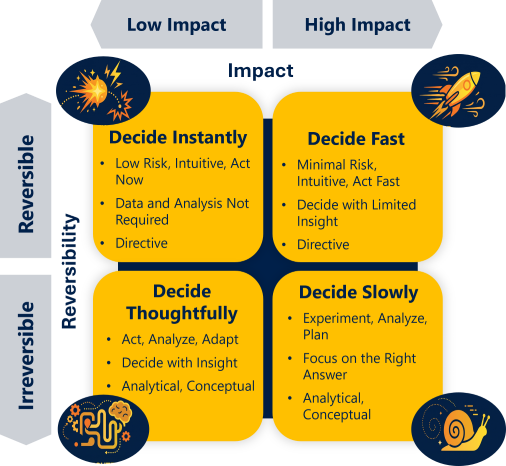
Different situations call for different decision-making strategies. To choose well, decision-makers should assess the factors that shape the choice, including urgency, importance, potential consequences, sensitivity, complexity, available information, and stakeholder impact. The examples that follow are not exhaustive, but they illustrate common situations and practical strategies leaders can use to improve the quality, speed, and acceptance of their decisions.
Business Decisions: Business decisions may be strategic, operational, or administrative. Decisions that materially affect strategic goals and objectives generally benefit from analytical rigor, collaboration, and democratic participation, helping ensure that options are carefully evaluated, plans are well developed, and stakeholders understand the shared direction. When the vision extends further into the future or requires innovation and creative thinking, conceptual, collaborative, and behavioral approaches can be especially valuable because they bring diverse perspectives and build commitment. By contrast, many routine, low-risk, and reversible daily decisions can be handled efficiently through a directive approach with limited analysis, consultation, or consensus. Repetitive and consistent administrative decisions may also be suitable for automation when the rules are clear, outcomes can be monitored, exceptions can be escalated, and appropriate human oversight remains in place.
Example: Selecting the placement of a button on a form—directive, delegated, or intuitive, supported by available design standards and user evidence.
Example: Defining one-year strategic goals—analytical, collaborative, and participative, with expert input where specialized knowledge is needed.
Example: Defining a three-year vision—conceptual, behavioral, and participative, supported by relevant expertise and evidence.
Personnel Decisions: Personnel decisions include employee training and development, performance management, responses to feedback, hiring, discipline, and termination. Decisions that affect a team or broader workforce—such as training priorities, shared performance expectations, or workplace policies—generally benefit from analytical rigor, collaboration, and democratic participation so the process reflects relevant evidence and affected perspectives. Decisions involving one individual (particularly hiring, performance, discipline, or termination) should be handled on a need-to-know basis and guided by directive and behavioral approaches, as this supports timely action while preserving empathy, dignity, and clear communication. Used well, these practices strengthen trust in leadership, improve confidence in the process, and balance organizational needs with fair and respectful treatment of employees.
Example: Developing a training plan for a team of developers—analytical, collaborative, democratic, and dependent on relevant technical or learning expertise.
Example: Conducting an individual performance review—behavioral and analytical, handled confidentially, with directive clarity around expectations and next steps.
Example: Hiring a candidate—analytical and collaborative, using structured, job-related criteria; intuition may inform judgment but should not replace evidence or consistency.
Compliance Decisions: Compliance decisions may involve obtaining a certification, meeting regulatory or contractual requirements, establishing legal authority to operate, or demonstrating social and environmental responsibility. The required outcome and governing criteria are often defined by laws, regulations, standards, or certification frameworks, but interpreting how they apply—and deciding whether to pursue a voluntary certification or commitment—may still require careful analysis, collaboration, and expert guidance. Once the decision to comply has been established, many routine compliance decisions can be handled through a directive approach using documented procedures, clear ownership, and defined escalation paths. Even then, leaders should continue to monitor evidence, regulatory changes, exceptions, and unintended consequences rather than assume that compliance is automatic or requires no judgment.
Example: Determining the appropriate Federal Aviation Administration (FAA) certification path and incorporating it into an aircraft development and sales plan—analytical and collaborative during planning; directive during execution once requirements and responsibilities are defined.
Example: Investing in workplace-safety compliance and hazard controls under applicable Occupational Safety and Health Administration (OSHA) requirements—analytical and collaborative when identifying risks and selecting controls; directive when implementing required procedures, training, reporting, and corrective actions.
Example: Establishing a socially responsible materials-sourcing program—analytical, behavioral, collaborative, and democratic, supported by risk-based due diligence, supplier engagement, traceability, monitoring, and clear escalation criteria.
Problem-Solving Decisions: Problem-solving decisions include risk mitigation, root-cause analysis, corrective action, and issue resolution. Complex or consequential problems generally benefit from analytical rigor, collaboration, and democratic participation, with input from subject-matter experts and the people closest to the work or affected by the outcome. A sound process defines the problem clearly, distinguishes symptoms from underlying causes, gathers relevant evidence, compares the benefits, drawbacks, risks, and feasibility of alternatives, and assigns ownership for implementation and follow-up. The level of participation and analysis should match the urgency, complexity, uncertainty, and potential impact: Straightforward, low-risk issues may be resolved quickly, while high-impact or community-facing problems require broader consultation, transparent reasoning, and careful monitoring. The goal is not simply to choose the most appealing option, but to select a practical, evidence-based response that addresses the cause, manages risk, and can be evaluated after implementation.
Example: Addressing a low-impact, low-likelihood risk—directive, when a simple control is proportionate; strategically accept and monitor the risk when treatment would cost more than the expected benefit, with a defined owner and review trigger.
Example: Resolving a high-impact, urgent, and complex issue—analytical and collaborative, with dependent use of subject-matter experts to confirm causes, assess alternatives, and support rapid, informed action.
Example: Investigating a problem affecting communities—analytical, behavioral, collaborative, and democratic, with early and meaningful community engagement, transparent communication, and attention to practical and social consequences.
Technology and Innovation Decisions: Decisions to pursue a new technology, launch a product line, or improve an existing offering usually benefit from a blend of conceptual, analytical, and behavioral approaches. Conceptual thinking expands the range of possibilities and encourages creative, future-focused ideas; analytical thinking tests assumptions, evidence, feasibility, risk, cost, and expected value; and behavioral thinking helps teams understand user needs, stakeholder concerns, and the organizational change required for adoption. Collaboration and democratic participation can create a psychologically safe environment where people challenge assumptions, experiment, learn from failure, and refine ideas without losing sight of decision rights or accountability. The strongest process moves deliberately from exploration to evaluation: Generate options broadly, test the most promising concepts through prototypes or pilots, use evidence to narrow the choices, and define clear criteria for scaling, revising, or stopping the initiative.
Example: Upgrading an enterprise resource planning system—analytical, collaborative, and democratic, with structured requirements, cross-functional input, risk assessment, testing, change management, and phased implementation.
Example: Exploring a new product—conceptual, behavioral, and collaborative, using customer insight, experimentation, feasibility analysis, and clear evidence-based criteria for investment and launch.
Example: Rebranding a product line—analytical, behavioral, collaborative, and democratic, informed by market research, brand strategy, customer and employee perspectives, and testing before full rollout.
Change Management Decisions: Whether the change involves a new system or process, organizational restructuring, relocation, or a shift in the working environment, leaders should carefully assess both the operational requirements and the effects on the people involved. Effective change decisions typically combine conceptual thinking to define the future state, analytical discipline to test assumptions and plan implementation, and behavioral awareness to understand concerns, readiness, and adoption needs. Collaboration, meaningful participation, and consensus-building can strengthen trust and buy-in, but they should be balanced with clear decision rights, visible sponsorship, transparent communication, and accountability. Leaders should explain why the change is needed, invite two-way feedback, address practical and human impacts with empathy, and define how progress and outcomes will be measured. The goal is not universal agreement on every detail, but informed participation, credible leadership, and sustained commitment to implementation.
Example: Relocating employees to a new work location—behavioral, analytical, collaborative, and consensus-oriented, with early consultation, transparent criteria, practical support, and clear communication about timing and impact.
Example: Implementing a new time-reporting system—conceptual first to define the desired future process, followed by analytical and collaborative approaches to evaluate requirements, gather user input, test the process, address privacy and control considerations, plan training, and manage the transition.
Example: Reorganizing a team or business unit— analytical, behavioral, and collaborative, with defined objectives, leadership accountability, careful role and workload analysis, two-way communication, and appropriate confidentiality for individual personnel matters.
These strategies are not an exhaustive or one-size-fits-all formula. Leaders should carefully evaluate each situation—including its urgency, complexity, risk, reversibility, available information, and stakeholder impact—and apply the combination of strategies that best fits the circumstances. Effective decision-making requires flexibility, sound judgment, and a willingness to adapt as conditions and evidence change.
Conclusion
Awareness is the first safeguard against distorted judgment, but it must be paired with vigilance. Leaders who recognize their default decision style, question familiar assumptions, watch for bias, and seek relevant evidence and opposing perspectives are better able to catch blind spots before they shape the outcome. This discipline does not eliminate bias or guarantee a perfect decision; it creates the pause needed to test instinct, adjust the process, and choose an approach that fits the situation.
Sound decision-making is, therefore, not defined by a single style, a flawless process, or the absence of bias. It is defined by the self-awareness to challenge instinct, the judgment to balance evidence with experience, and the flexibility to know when to move quickly, pause for deeper analysis, seek expertise, or invite broader participation. Ultimately, leadership is reflected not only in the decisions made, but also in the clarity of the reasoning, the fairness of the process, the accountability behind the action, and the trust built while turning decisions into results.
